 Innovate
  Accelerate
  Engineers & Experience
  Quality Assurance
  Salesforce
  Application Development and Maintenance
  Full Cycle Development
  Consulting Services
  Staff Augmentation
  eCommerce
  Education
  Fintech
  Health & Wellness
  Healthcare
  Logistics
  Media & Entertainment
  Real Estate
  Travel
  Sports




Performance Testing Services
Software performance testing services evaluate how an application responds to expected demand, sudden traffic increases, and sustained activity. They measure responsiveness, stability, and capacity against defined business requirements.
Share your application, critical workflows, expected demand, and target release date. Start with a defined testing scope rather than a generic virtual-user package.
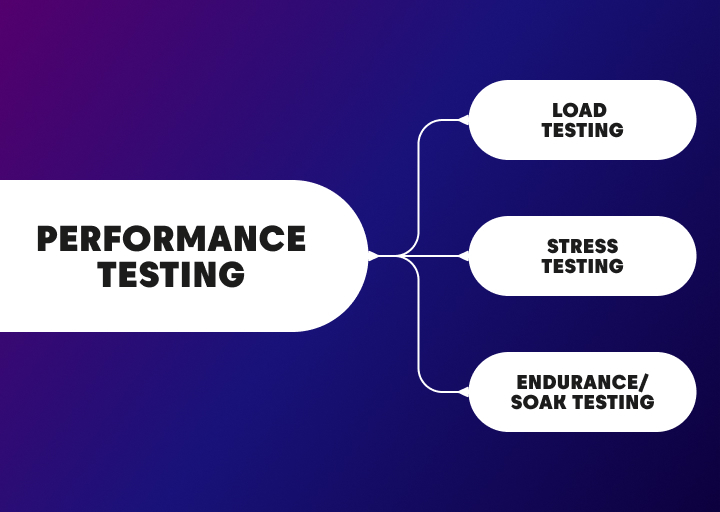
Appinventors provides performance testing for web applications, mobile applications, APIs, and software systems. Our services cover load, stress, spike, endurance, and scalability testing.
Whether you are preparing for a product launch, investigating slow transactions, or planning for growth, start with evidence about what your application can handle and what needs attention.
Fictional example—not a live test or client result. The failure criterion is not met. Read the report interpretation →
Can Your Application Handle Your Next Traffic Peak?
A checkout, booking, or reporting workflow may function correctly during individual testing but behave differently when demand increases. Performance testing evaluates those workload conditions before you rely on assumptions about capacity.
For engineering leaders, QA managers, and product owners, the important questions are practical:
Release readiness
Will critical transactions meet their performance targets at the expected workload?
Bottleneck investigation
Where does performance deteriorate, and what evidence can help explain it?
Capacity planning
Which tested configuration supports the demand you need to accommodate?
Our starting point is the decision your team needs to make. That decision determines the workflows, workload model, measurements, and acceptance criteria—not simply the highest number of users a tool can simulate.
Which Load and Performance Testing Services Do You Need?
Load Testing for Expected and Peak Demand
Evaluate response times, throughput, and failures under a defined workload. Load testing establishes whether selected application workflows meet their requirements at the demand you expect to support.
Use it before a release, promotional event, or planned increase in customer activity. Normal demand and expected peak demand should be documented separately.
Stress Testing for Higher-Than-Expected Demand
Examine how the application behaves when activity rises above normal operating conditions. Stress testing helps investigate performance degradation and how the system responds as pressure increases.
Use it when you need to understand the risks beyond your expected workload—not just confirm performance at an ordinary operating level.
Spike Testing for Sudden Traffic Surges
Assess the response to a rapid increase in activity, such as a concentrated product launch or promotional campaign.
The size and speed of the increase should reflect the scenario being evaluated. There is no universal requirement to double traffic or use the same multiplier for every application.
Endurance Testing for Sustained Operation
Run an agreed workload over an extended period to investigate problems that shorter tests may miss. These can include accumulating memory consumption, resource exhaustion, and gradually deteriorating response times.
Use endurance testing for applications expected to operate continuously or handle lengthy periods of sustained demand.
Scalability and Capacity Assessment
Compare performance as workload and available resources change. Assess whether scaling behavior supports the required demand and identify the conditions under which performance targets are met.
Capacity findings apply to the tested configuration. They should not be presented as proof that additional infrastructure will always produce proportional improvement.
API Performance Testing
Evaluate individual endpoints and connected transaction flows under load. The scope can address authentication, response validation, request duration, throughput, and application-level failures.
A successful HTTP response does not automatically prove that the intended business transaction succeeded. API tests should validate the expected outcome as well as the response status.
Web and Mobile Application Performance Testing
Assess backend behavior alongside selected user journeys. For web applications, protocol-level load generation can be combined with browser-based measurements to examine both server responsiveness and frontend experience.
Device-specific requirements should be defined separately. Explore our mobile app testing services for broader mobile coverage and web application testing services for related browser and application-quality requirements.
What Do Application Performance Testing Services Measure?
The measurement plan should show whether important workflows remain responsive, complete correctly, and stay within agreed operating limits.
Response time alone is not enough. Latency, traffic, errors, and resource saturation provide complementary information about application behavior.
| Measurement | What it helps establish |
|---|---|
| Response-time percentiles | How typical requests and slower requests behave, rather than relying only on an average. |
| Attempted and completed throughput | How much work reaches the application and how much completes successfully. |
| Errors and timeouts | Whether increased demand causes failed or abandoned operations. |
| Transaction correctness | Whether the expected business outcome occurs. |
| Resource utilization and saturation | Where infrastructure or application resources may constrain performance. |
| Stability during sustained activity | Whether performance deteriorates as the test continues. |
Swipe or scroll sideways to view the full table.
The selected measurements should distinguish request-level behavior from complete business transactions and connect failures to the workflows affected.
What Is Included in Your Performance Testing Engagement?
The core engagement covers requirements review, test planning, scripting, scheduled execution, and reporting. Appinventors’ published process includes scope estimation and approval of the test plan before test execution.
The statement of work defines the workflows, workload levels, test cycles, reporting requirements, and handoff assets.
| Deliverable | What the agreed scope should specify |
|---|---|
| Performance test plan | Business objectives, selected workflows, environment, assumptions, acceptance criteria, and exclusions. |
| Workload model and scripts | Transaction mix, demand pattern, test data requirements, script validation, and reusable assets included in the handoff. |
| Execution record | Application version, infrastructure configuration, test duration, workload achieved, and material events during each run. |
| Results report | Measurements for the agreed scenarios, comparison with targets, and documented limitations. |
| Findings and next actions | Observed problems, supporting evidence, investigation priorities, and responsibilities for follow-up. |
| Retest comparison, when included | Baseline-versus-retest findings under controlled, comparable conditions. |
Swipe or scroll sideways to view the full table.
Testing and fixing are different workstreams. Code changes, database tuning, infrastructure changes, additional test cycles, and deployment-pipeline integration must be explicitly included rather than assumed.
Tell us whether your priority is a release decision, a recurring slowdown, or a capacity question.
How Does the Performance Testing Process Work?
1. Define the Business Decision
Identify the release, operational concern, or capacity requirement the testing must support.
Prioritize the workflows whose slowdown or failure would have the greatest consequence. Agree on what the engagement needs to establish and what remains outside its scope.
2. Confirm Environment Readiness
Provide a stable build, access to a dedicated test environment, and an agreed execution window. Appinventors lists application stability, avoiding immediate feature rollouts, and a dedicated test environment among its testing prerequisites.
Document differences from production so they remain visible when interpreting results.
3. Approve the Workload and Acceptance Criteria
Define transaction mix, arrival rate or concurrency, test duration, workload progression, and stopping conditions.
Use available usage data and business forecasts to inform the model. Where demand is uncertain, label assumptions and test scenarios rather than presenting forecasts as established facts.
4. Build and Validate the Scripts
Check authentication, session handling, dynamic data, and transaction outcomes. Begin with minimal load to confirm that the scripts exercise the intended workflows correctly.
A larger test is not useful when its virtual users repeatedly fail before reaching the operation being evaluated.
5. Execute Tests and Investigate Findings
Run the approved scenarios and review workload behavior alongside available application and infrastructure measurements.
Record environment changes, unexpected dependencies, and deviations from the planned workload. These details help determine whether the evidence supports a conclusion or requires another test.
6. Review Results and Validate Changes
Compare results with the agreed criteria. Identify the next action: proceed within tested limits, investigate and remediate, or collect additional evidence.
Where retesting is included, compare the baseline and changed system under equivalent conditions. Changing the workload and infrastructure simultaneously can make an improvement difficult to attribute.
Which Testing Scope Fits Your Current Need?
You do not need to begin with every test type. Start with the business risk or decision that matters most.
The following are scoping options, not fixed-price packages.
| Your immediate need | Suggested starting scope | Important boundary |
|---|---|---|
| Investigate a specific slowdown | Reproduce the affected workflow, establish a baseline, and examine available supporting measurements. | Confirm whether the underlying dependencies and monitoring data are accessible. |
| Assess an upcoming release | Test critical journeys against expected and peak demand, with agreed pass-or-fail criteria. | Define which workflows, configurations, and demand scenarios are covered. |
| Plan for growth or infrastructure changes | Compare workload levels or infrastructure configurations. | Keep comparison conditions controlled and document the limits of the findings. |
| Detect performance regressions across releases | Repeat selected baseline tests against future versions. | Define execution frequency, environment ownership, maintenance, and reporting responsibilities. |
Swipe or scroll sideways to view the full table.
For repeatable validation, discuss how selected performance checks fit alongside your existing automated software testing. Automation can support recurring checks, but the workload, environment, and acceptance criteria still require maintenance.
How Much Do Software Performance Testing Services Cost?
Request a scope-based estimate in USD that separates engineering effort from tooling, infrastructure, and additional test cycles.
The estimate should account for the applications and APIs involved, workflow complexity, authentication requirements, test-data preparation, workload scale, duration, monitoring access, reporting depth, and retesting.
A focused investigation of one workflow is a different engagement from a multi-system release assessment. Define those boundaries before comparing proposals.
What Should Your Estimate Make Clear?
Your proposal should identify the selected scenarios, number of test cycles, deliverables, schedule assumptions, and exclusions.
It should also state whether load-generation infrastructure, commercial tools, environment preparation, and permitted third-party usage charges are included or billed separately.
How Can You Keep the Scope Focused?
Start with the highest-priority transactions and the decision you need to make. Provide existing workload data and usable monitoring access where available.
Do not remove validation or reporting simply to reduce the execution cost. Instead, distinguish essential coverage from additional scenarios that can be evaluated in a later phase.
How Long Does a Performance Testing Project Take?
For early planning, a focused assessment can be modeled at approximately one to three weeks after the required environment, access, requirements, and test data are ready.
| Planning stage | Illustrative allowance |
|---|---|
| Scope confirmation and workload design | 1–2 business days |
| Script development and validation | 2–5 business days |
| Test execution and investigation | 1–3 business days |
| Reporting and results review | 1–2 business days |
| Modeled total | 5–12 business days |
Remediation, additional retesting, extended endurance runs, complex integrations, and environment provisioning are outside this example.
The project schedule should be confirmed after reviewing the actual scope and readiness. Include preparation and analysis in that schedule—not just the time during which a load test runs.
What Prevents Misleading Performance Results?
Model Demand, Not Just a Virtual-User Count
A fixed number of virtual users does not necessarily generate a fixed rate of incoming work.
In a closed workload model, slower responses can reduce how frequently new iterations begin. When the objective is to simulate independently arriving demand, an arrival-rate model may be more appropriate.
The practical question is: Does the test continue applying the intended demand when the application slows down?
Make Environment Differences Explicit
A smaller test environment can reveal useful problems without proving production capacity. Differences in compute resources, caching, scaling settings, data volumes, and dependencies affect the interpretation of results.
Document those differences beside the findings rather than hiding them in a general disclaimer.
Separate Observations From Confirmed Causes
A slow checkout is an observation. A database bottleneck is a possible explanation that requires supporting evidence.
Logs, metrics, and traces provide different forms of information for investigating system behavior. The report should distinguish a confirmed cause from a hypothesis that still needs validation.
Do Not Treat an Invalid Test as a Pass
A run that misses the intended workload, uses broken scripts, or lacks required measurements may be inconclusive.
For the proposed reporting approach, use three explicit outcomes: criteria met under tested conditions, criteria not met, or insufficient evidence. This prevents an incomplete run from becoming an unsupported release recommendation.
What Does a Performance Test Result Actually Tell You?
Illustrative report interpretation—not a client case study, executed test, or universal benchmark.
Consider a fictional checkout assessment with 3,000 attempted transactions. Suppose the agreed criteria require completed checkouts to have a p95 duration below two seconds and the overall transaction failure rate to remain below 0.5%.
| Measurement | Illustrative criterion | Fictional result | Interpretation |
|---|---|---|---|
| p95 duration of completed checkouts | Below 2 seconds | 1.8 seconds | Duration criterion met for completed checkouts |
| Failed or timed-out attempts | Below 0.5% of all attempts | 18 out of 3,000: 0.6% | Failure criterion not met |
| Overall decision | Both criteria must be met | One criterion fails | Acceptance criteria not met |
Swipe or scroll sideways to view the full table.
The application should not receive a passing assessment simply because successful checkouts were fast.
In this example, failed and timed-out attempts remain in the failure-rate calculation. The next step would be to investigate those failures and validate any changes under comparable conditions.
The targets and numbers are fictional. Their purpose is to show how explicit criteria support a decision—not to imply an Appinventors client result.
Which Business Workflows Should Be Prioritized?
The following are illustrative scoping examples, not claims about completed performance-testing projects.
Ecommerce and retail
Product search, cart updates, checkout, inventory checks, and order confirmation during promotional demand.
SaaS platforms
Sign-in, dashboards, account administration, imports, and reporting across multiple customer accounts.
Travel and booking
Availability searches, reservation changes, booking confirmation, and connections to external inventory services.
Logistics and field operations
Dispatch actions, shipment updates, tracking requests, and operational dashboards.
Enterprise applications
Employee access, document processing, integrations, and reporting during concentrated working-hour activity.
For each workflow, define expected demand, successful completion, acceptable duration, and the consequence of missing the target.
Which Tools Can Support Your Testing Scope?
Tool selection should follow the application, protocols, measurement requirements, and handoff needs. The tools below are options to evaluate—not a claim that every engagement includes each one.
Apache JMeter
Apache JMeter supports protocol-level testing for web services and other supported systems. It does not render pages or execute page JavaScript like a browser, so it should not be treated as a substitute for browser-experience measurement.
Grafana k6
Grafana k6 supports scripted workloads and metric thresholds. Browser-based tests can complement protocol-level load where selected frontend journeys also need evaluation.
Existing monitoring and OpenTelemetry instrumentation
Existing monitoring and OpenTelemetry instrumentation can provide logs, metrics, and traces for investigation. The useful signals depend on what is instrumented and accessible in the environment.
Confirm tool licensing, execution infrastructure, access requirements, and asset ownership during scoping.
How Will Access, Test Data, and Live-System Risk Be Handled?
Start with a dedicated non-production environment and an agreed testing window, consistent with Appinventors’ published prerequisites.
Before execution, define test accounts, permitted access, approved data, external dependencies, escalation contacts, stopping conditions, and cleanup responsibilities. Use synthetic or appropriately sanitized data where practical.
What Appinventors Experience Can You Review?
Appinventors’ published offering spans software consulting, application development, and QA services. Its customer feedback includes broader software-delivery engagements involving Keyhabits and Sunset Destination Tour and Travel.
These references concern broader application work—not measured performance-testing improvements. Review the Appinventors portfolio for application context, while evaluating testing-specific evidence separately.
For buyers, Appinventors lists a contact office in Torrance, California, and a telephone number. Testing schedules, communication overlap, and delivery responsibilities should be defined for the engagement rather than inferred from the office location.
Frequently Asked Questions
What Is the Difference Between Performance Testing and Load Testing?
Performance testing is the broader assessment of application behavior under defined conditions. Load testing focuses on a specified workload.
Other test types examine sustained activity, sudden surges, or demand beyond normal expectations. The right combination depends on the question being investigated.
How Many Concurrent Users Should We Test?
Use workload data and business requirements to determine the target. Concurrent users, requests per second, and completed transactions are different measurements.
Define what each simulated user does and whether new activity should arrive independently of response times before choosing a virtual-user count.
Do You Need Source-Code Access?
Protocol-level testing can exercise accessible application interfaces without source-code access. Test accounts, suitable permissions, and access to the required endpoints are still necessary.
Source code and internal monitoring may be needed for deeper diagnosis or implementation work, depending on the issue and scope.
Can Third-Party APIs Be Included?
Only include external systems within the approved testing scope and permitted usage.
Decide whether each dependency will be exercised directly, represented by a controlled substitute, or excluded. A substituted dependency should not be reported as though the actual external service was validated.
Is Performance Optimization Included?
Not automatically. Testing identifies and measures problems; remediation changes the application or infrastructure.
The statement of work should explicitly cover any code changes, database tuning, configuration work, or validation after fixes.
Can Tests Be Repeated Across Releases?
Yes, selected performance tests can be automated and repeated against later application versions.
Maintain the scripts, test data, environment assumptions, and thresholds so that comparisons remain meaningful. A successful automated run is useful only when it still represents the workload and requirements being evaluated.
What Happens When the Application Misses a Target?
Review the affected workflow, evidence, and business consequence. Assign responsibility for investigation and any changes, then define the conditions for a retest.
Repeating the same run without understanding the failure or changing the relevant conditions is not a remediation plan.
Does Passing a Performance Test Guarantee Zero Downtime?
No. A passing result applies to the workload, configuration, data, and duration evaluated.
It does not eliminate every failure mode or prove how the application will behave under all future conditions. Performance validation should continue as the application and its workload change.
Make Your Next Release Decision With Performance Evidence
Preparing for a launch, investigating slow transactions, or planning for higher demand?
Discuss your software performance testing services requirements with Appinventors. Start with your application, the workflows that matter, the workload you expect, and the decision your team needs to make.