 Innovate
  Accelerate
  Engineers & Experience
  Quality Assurance
  Salesforce
  Application Development and Maintenance
  Full Cycle Development
  Consulting Services
  Staff Augmentation
  eCommerce
  Education
  Fintech
  Health & Wellness
  Healthcare
  Logistics
  Media & Entertainment
  Real Estate
  Travel
  Sports




AI Development Services Built Around Real Business Workflows
Appinventors provides artificial intelligence development services for businesses that want to automate processes, build AI-enabled applications, improve decision-making, and turn company data into practical software capabilities.
Retrieve · Reason · Validate
We help organizations move from an AI idea to a production-ready solution through strategy, use-case assessment, data preparation, model and platform selection, application development, integration, testing, deployment, and ongoing optimization. Our AI development services can support generative AI applications, AI agents, machine learning systems, intelligent automation, predictive analytics, natural language processing, and computer vision.
Whether you are modernizing an existing platform or developing a new AI product, our team focuses on measurable business requirements, security, maintainability, and integration with the systems your organization already uses.
What Do Artificial Intelligence Development Services Include?
Artificial intelligence development services cover the design, development, integration, and maintenance of software that uses AI to perform tasks such as understanding language, generating content, analyzing data, recognizing patterns, predicting outcomes, or automating multi-step workflows.
Our AI capabilities include:
Generative AI Development
Build applications that use large language models (LLMs) for content generation, summarization, knowledge retrieval, document processing, customer support, and internal productivity.
Depending on the use case, solutions can integrate commercial model APIs or suitable open-source models while maintaining application-level security and access controls.
AI Agent Development
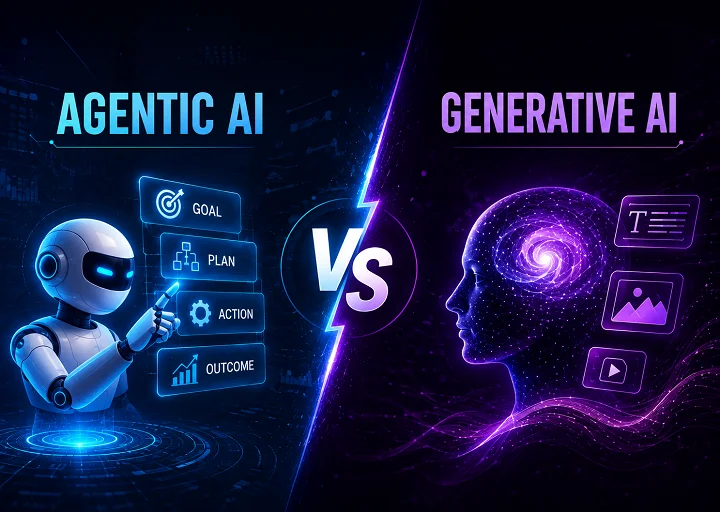
Develop AI agents that can interpret requests, access approved tools and business data, perform defined actions, and coordinate multi-step workflows.
Agentic systems can support customer service, sales operations, employee assistance, research, document processing, and other structured business processes.
Machine Learning Development
Design machine learning solutions for forecasting, classification, recommendations, anomaly detection, risk assessment, and pattern recognition.
The appropriate approach depends on available data, required accuracy, explainability, latency, and operational constraints.
Natural Language Processing
Use NLP to analyze and process text, documents, conversations, feedback, and other language-based information. Applications can include semantic search, sentiment analysis, information extraction, classification, and conversational interfaces.
Computer Vision
Build software that analyzes images or video for use cases such as object recognition, visual inspection, document processing, monitoring, and image classification.
AI Application Development
As an AI app development company, Appinventors can integrate AI capabilities into web applications, mobile apps, SaaS products, enterprise platforms, and existing digital systems rather than treating the model as a standalone technology.
How Our AI Consulting Services Help Define the Right Use Case
Successful AI projects begin with a clearly defined business problem-not simply a decision to “add AI.”
Our AI consulting services help businesses evaluate where AI is technically appropriate and commercially useful. We assess the workflow, available data, users, integrations, security requirements, expected output, and operational constraints before recommending an architecture.
This process can prevent teams from investing in an AI implementation where a simpler software or automation approach would produce a more predictable result.
Our AI Development Process
Discovery and Use-Case Assessment
We define the business objective, target users, workflows, data requirements, success criteria, integrations, risks, and technical constraints.
Data and Architecture Planning
Our team evaluates data availability and determines the appropriate application architecture, model strategy, APIs, databases, cloud infrastructure, security controls, and integration approach.
Prototype and Validation
For use cases with technical uncertainty, a focused prototype can validate model behavior, response quality, workflow feasibility, latency, and integration requirements before full development.
AI Application Development
We develop the application layer, AI functionality, backend services, interfaces, integrations, authentication, data workflows, and administrative controls required for the production system.
Testing and Evaluation
Testing can include functional validation, model-output evaluation, edge cases, performance, security, hallucination risks, permissions, and failure handling. AI systems require testing of both conventional software behavior and probabilistic model output.
Deployment and Optimization
After deployment, AI applications should be monitored for output quality, usage patterns, latency, errors, model costs, and changing business requirements. Models, prompts, retrieval pipelines, and workflows can then be refined based on production evidence.
AI Technologies and Integration Capabilities
Technology selection should follow the business requirement rather than forcing every project onto the same AI stack.
Depending on project requirements, an AI solution may incorporate LLM APIs, open-source models, Python-based machine learning frameworks, vector databases, retrieval-augmented generation (RAG), cloud AI services, APIs, enterprise databases, and existing web or mobile applications.
We can also connect AI applications with CRM, ERP, customer support, document management, analytics, communication, and other business systems where technically supported.
across the architecture
For sensitive applications, architecture decisions should also consider data access, encryption, authentication, authorization, auditability, retention, model-provider policies, and human oversight.
Where Can Businesses Use AI?
AI creates the most value when it addresses a defined workflow with measurable inputs and outcomes. Common applications include:
Customer support
Customer-support assistants that retrieve information from approved knowledge sources.
Document processing
Document-processing systems that extract, classify, and summarize information.
Personalized experiences
Recommendation engines that personalize products or content.
Predictive planning
Predictive systems for demand, risk, or operational planning.
Employee knowledge
Internal AI assistants that help employees search company knowledge.
Other business workflows
Other opportunities include intelligent workflow automation, fraud or anomaly detection, sales-support tools, visual inspection, conversational applications, and AI features embedded within existing SaaS or mobile products.
The right implementation depends on business value, data quality, risk, accuracy requirements, and the cost of operating the system.
How Much Does AI Development Cost?
There is no reliable fixed price for a custom AI project without defining its scope.
Cost depends on factors such as application complexity, data preparation, model choice, number of integrations, custom model requirements, user roles, security requirements, infrastructure, interface complexity, testing, and ongoing model usage.
A relatively focused AI feature that uses an existing model API requires substantially different engineering effort from a multi-system AI platform with private data retrieval, custom workflows, multiple user roles, human approval, and production monitoring.
For this reason, a technical discovery session is usually the most useful first step toward establishing budget and timeline expectations.
When Should You Hire AI Developers?
You should consider hiring AI developers when your project requires more than connecting an AI API to an interface.
Experienced AI developers can help when you need to design retrieval pipelines, integrate enterprise data, evaluate model output, build agent workflows, implement machine learning pipelines, establish guardrails, optimize performance, or connect AI functionality with production applications.
With Appinventors, businesses can hire AI developershttps://appinventors.com/contact/ for defined projects, dedicated development requirements, or collaboration with an existing internal engineering team.
Defined projects
Develop around an agreed use case and scope.
Dedicated development
Support ongoing AI engineering requirements.
Team collaboration
Work alongside your internal engineering team.
What Should You Look for in an AI Development Company?
Evaluate an AI development partner on its ability to connect AI engineering with production software development.
Look for a team that can explain why a particular AI architecture is appropriate, how your data will be handled, how model output will be evaluated, what happens when the model produces an incorrect response, and how the system will be monitored after launch.
The partner should also understand application engineering, APIs, cloud infrastructure, databases, security, user experience, and integration-not only model selection.
Appinventors approaches AI development as a complete software engineering problem, from business requirements and AI architecture through application development, integration, testing, and post-launch improvement.
What are AI development services?
AI development services involve designing, building, integrating, and maintaining software that uses artificial intelligence. Projects can include generative AI, machine learning, AI agents, NLP, computer vision, predictive analytics, and intelligent automation.
Can AI be integrated into an existing application?
Yes. AI capabilities can often be integrated into existing web, mobile, SaaS, or enterprise applications through APIs, application services, retrieval systems, and data integrations. Feasibility depends on the current architecture and data environment.
How long does an AI development project take?
The timeline depends on scope, data readiness, integrations, model complexity, testing requirements, and whether custom research or model training is necessary. A focused AI feature may require far less time than a complex enterprise AI platform.
Do we need our own AI model?
Not necessarily. Many applications can use existing commercial or open-source models. Custom training or fine-tuning should be considered when business requirements, proprietary data, accuracy, control, or operating economics justify the additional effort.
Can you develop generative AI and AI agent applications?
Yes. Generative AI can be used for language- and knowledge-based workflows, while AI agents can combine models with tools, APIs, data, and defined business actions. The architecture should include appropriate permissions, validation, and human oversight based on the risk of the task.
How do we start an AI development project?
Start by identifying a specific workflow, user problem, or business outcome. Appinventors can then assess technical feasibility, data requirements, integration needs, risks, architecture, and development scope before implementation begins.
Build AI Around a Business Problem Worth Solving
AI should make a workflow more useful, efficient, scalable, or informed-not simply add another technology layer.
Appinventors combines AI consulting services, application engineering, AI integration, and development expertise to help businesses move from a defined use case to production software.
Whether you need a generative AI application, AI agent, machine learning system, intelligent automation solution, or AI capability integrated into an existing product, start by defining the business outcome and technical requirements.