 Innovate
  Accelerate
  Engineers & Experience
  Quality Assurance
  Salesforce
  Application Development and Maintenance
  Full Cycle Development
  Consulting Services
  Staff Augmentation
  eCommerce
  Education
  Fintech
  Health & Wellness
  Healthcare
  Logistics
  Media & Entertainment
  Real Estate
  Travel
  Sports




IT Staff Augmentation Services to Extend Your Technology Team
Add experienced technology professionals to your existing team without committing to a long permanent hiring cycle.
Appinventors provides IT staff augmentation services for businesses that need developers, engineers, QA professionals, cloud specialists, data experts, designers, and other technology talent for specific skills, projects, or periods of increased demand.
Our staff augmentation model is designed for organizations that want to retain control of their projects while adding the technical capacity they need. You manage priorities, product direction, and day-to-day collaboration while augmented professionals work as an extension of your internal team.
What Are IT Staff Augmentation Services?
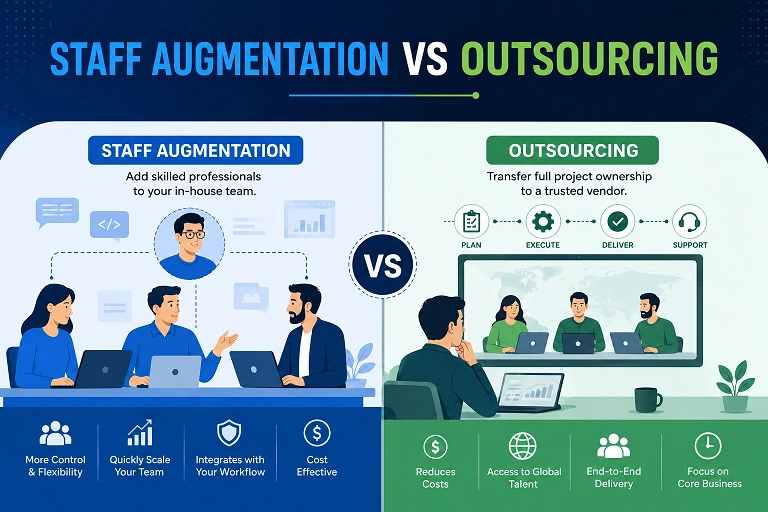
IT staff augmentation is a flexible hiring model that allows a company to add external technology professionals to its internal team for a defined period or workload.
Instead of outsourcing an entire project, your organization continues to manage the work while additional specialists contribute the skills or capacity your existing team needs.
For example, a company may use staff augmentation when it needs:
- A React developer for a product release
- Additional QA engineers before launch
- Cloud specialists for an infrastructure migration
- Mobile developers for an iOS or Android application
- Data engineers for a new analytics initiative
- DevOps engineers to strengthen deployment workflows
- AI or machine learning specialists for a specific capability
- Additional developers during a high-demand delivery period
This approach can be useful when permanent hiring does not match the duration, urgency, or specialization of the requirement.
When Does IT Staff Augmentation Make Sense?
Staff augmentation works best when your company already has internal project ownership but needs additional people, skills, or delivery capacity.
01
You Have a Temporary Skill Gap
Your team may understand the product but lack expertise in a specific framework, platform, cloud environment, integration, or engineering discipline.
Rather than building an entirely new internal capability for a temporary requirement, you can add specialists who complement the existing team.
02
Your Development Backlog Is Growing
A growing backlog can put additional pressure on internal engineers.
Adding developers, QA professionals, or other specialists can help distribute work across more resources while your existing leadership continues to control priorities and release planning.
03
You Need Specialized Technology Expertise
Some initiatives require skills that may not be needed permanently.
Examples include:
- AI and machine learning
- Cloud migration
- DevOps implementation
- Legacy application modernization
- Mobile platform development
- Performance engineering
- Cybersecurity
- Data engineering
- Business intelligence
- Enterprise integrations
Staff augmentation allows businesses to access specialized expertise without changing their entire organizational structure.
04
You Need Additional Capacity for a Product Release
Major releases often require more engineering and testing capacity than normal operating periods.
Additional technical professionals can support development, QA, integration testing, migration, documentation, release preparation, and post-launch stabilization.
05
You Want to Keep Project Management Internally
Staff augmentation is particularly useful when your company wants direct oversight of:
- Technical priorities
- Product decisions
- Sprint planning
- Architecture
- Work allocation
- Communication
- Release schedules
The augmented professionals work inside your delivery structure rather than taking ownership of the complete project.
IT Staff Augmentation Services We Provide
Our staff augmentation services can support different stages of software development, digital transformation, modernization, cloud, data, and technology operations.
01
Software Developer Staff Augmentation
Extend your engineering team with developers aligned with your current technology stack and product requirements.
Roles can include:
- Front-end developers
- Back-end developers
- Full-stack developers
- API developers
- Enterprise application developers
- SaaS developers
- CMS developers
- Integration engineers
Augmented developers can participate in sprint planning, coding, code reviews, debugging, documentation, and ongoing product development.
02
Mobile App Development Staff Augmentation
Add mobile professionals to support new applications, existing products, upgrades, or platform-specific initiatives.
Available skill areas can include:
- iOS development
- Android development
- Flutter
- React Native
- Cross-platform application development
- Mobile API integration
- Mobile application testing
- App maintenance and modernization
The team can work within your current development practices and product roadmap.
03
QA and Software Testing Staff Augmentation
Add testing capacity when your development volume increases or when a release requires broader validation.
Staff augmentation can support:
- Functional testing
- Automated testing
- Regression testing
- API testing
- Mobile application testing
- Web application testing
- Performance testing
- Compatibility testing
- Test automation engineering
QA professionals can work alongside your existing developers and testing teams throughout the development lifecycle.
04
Cloud and DevOps Staff Augmentation
Add technical resources for cloud infrastructure, CI/CD, deployment automation, environment management, and platform operations.
Skill areas can include:
- AWS
- Microsoft Azure
- Google Cloud
- Docker
- Kubernetes
- Infrastructure as Code
- CI/CD pipelines
- Cloud migrations
- Monitoring
- DevOps automation
The appropriate team structure depends on your existing infrastructure and the responsibility assigned to augmented professionals.
05
Data, AI and Machine Learning Staff Augmentation
Build additional capacity for data-intensive and AI initiatives without creating an entirely new internal department.
Specialists can support:
- Data engineering
- Data pipelines
- Machine learning development
- Generative AI applications
- AI integration
- LLM-based applications
- Analytics solutions
- Business intelligence
- Data visualization
- Model integration and application development
Before assigning resources, the technical scope should clearly define the data environment, integrations, security requirements, expected outputs, and ownership responsibilities.
06
UI/UX Design Staff Augmentation
Add designers to existing product and engineering teams for:
- Product UX
- Interface design
- Wireframes
- Interactive prototypes
- Design systems
- Mobile UX
- Web application UX
- User flow optimization
- Developer handoff
Design professionals can work inside your existing product development process rather than operating as a separate external project team.
07
Project Management and Business Analysis Support
Technology delivery may require additional coordination as teams or project complexity increase.
Staff augmentation can include:
- Project managers
- Scrum Masters
- Business analysts
- Product analysts
- Technical coordinators
- Delivery managers
These professionals can help organize requirements, dependencies, communication, sprint activities, documentation, and stakeholder coordination.
What IT Roles Can You Augment?
The right resource mix depends on your current team and the work that needs to be completed. Common roles include:
Engineering
- Front-End Developers
- Back-End Developers
- Full-Stack Developers
- Mobile Developers
- QA Engineers
- Automation Engineers
- API Developers
Cloud & Data
- Cloud Engineers
- DevOps Engineers
- Data Engineers
- Data Scientists
- AI/ML Engineers
- BI Developers
- Database Specialists
Product & Delivery
- Project Managers
- Scrum Masters
- Business Analysts
- UI/UX Designers
- Product Specialists
- Technical Leads
- Solution Architects
If a project requires several related skills, the engagement can combine multiple roles rather than adding individual specialists independently.
Choose the Right Staff Augmentation Model
Different projects require different staffing structures.
01
Individual Specialist
Best suited for a specific skill gap.
Example:
Your product team needs an experienced Flutter developer to work alongside existing backend, design, and QA teams.
Appropriate when
- The gap is clearly defined
- Your internal team already covers other disciplines
- You need a specific technology skill
- Internal management capacity already exists
02
Multiple Team Members
Add several technology professionals across one or more disciplines.
Example:
A company needs two backend developers, a front-end engineer, and a QA engineer to increase capacity for an upcoming release.
Appropriate when
- Several workstreams need additional resources
- Delivery demand has increased
- A release requires temporary additional capacity
- Your internal technical leadership will manage the expanded team
03
Cross-Functional Team Extension
Add a coordinated group of professionals covering several technical disciplines.
This can include developers, testers, designers, DevOps engineers, and other roles.
Appropriate when
- The internal team needs substantial capacity
- Multiple skill gaps exist
- A new workstream needs dedicated resources
- The organization wants to maintain internal product ownership
04
Specialized Skill Augmentation
Bring in expertise for a specific technical initiative.
Examples include:
- Cloud migration
- AI integration
- Application modernization
- Performance engineering
- DevOps transformation
- Data architecture
- Enterprise integrations
This model can be useful where specialist expertise is required for only part of a broader program.
How Does the IT Staff Augmentation Process Work?
A successful engagement starts by defining the work—not simply requesting more developers.
Define the Skills and Responsibilities
We begin by understanding:
- Technology stack
- Required roles
- Experience level
- Project responsibilities
- Current team structure
- Collaboration expectations
- Time-zone requirements
- Engagement duration
- Security considerations
- Expected start requirements
Clear requirements improve candidate matching and reduce onboarding friction.
Review Relevant Talent
Profiles are matched against the technical and project requirements.
Your team can review relevant experience, technical capabilities, availability, and other information required for your evaluation process.
Conduct Your Technical Evaluation
Your organization should remain involved in the selection process.
Depending on your hiring process, evaluation can include:
- Technical interviews
- Architecture discussions
- Coding assessments
- Portfolio review
- Role-specific interviews
- Communication assessment
This helps ensure that the selected professional matches both the technical requirement and the way your team works.
Complete Onboarding and Access Setup
Once selected, the professionals are introduced to the project environment.
Typical onboarding may cover:
- Development standards
- Product documentation
- Repository access
- Communication tools
- Task management platforms
- Security policies
- Coding practices
- Release workflows
Access should always follow your organization's security and least-privilege requirements.
Integrate the Professional Into Your Delivery Process
Augmented team members can participate in your existing activities, including:
- Daily stand-ups
- Sprint planning
- Code reviews
- Architecture discussions
- QA cycles
- Retrospectives
- Documentation
- Release planning
This keeps project management and technical decisions aligned with your internal team.
Review Capacity and Adjust When Required
Resource requirements often change over the life of a project.
The engagement can be reviewed based on:
- Workload
- Upcoming milestones
- Required skills
- Project phase
- Performance
- Product roadmap
The objective is to maintain the appropriate team structure rather than adding resources that are no longer required.
How Do Augmented IT Professionals Work With Your Existing Team?
Augmented professionals should operate as an integrated part of your delivery environment.
Your organization normally continues to manage:
- Product ownership
- Roadmap decisions
- Prioritization
- Technical governance
- Project direction
- Internal stakeholder communication
Augmented professionals contribute within the responsibilities defined for their roles.
They may work through collaboration and project platforms such as:
The exact setup should follow your existing development and security standards.
Staff Augmentation vs. Outsourcing vs. Permanent Hiring
These models solve different business problems.
| Factor | IT Staff Augmentation | Project Outsourcing | Permanent Hiring |
|---|---|---|---|
| Project control | Primarily internal | Shared or external | Internal |
| Day-to-day management | Internal team | Service provider/project structure | Internal |
| Best for | Capacity or skill gaps | Defined project delivery | Long-term organizational roles |
| Team integration | High | Varies by model | High |
| Engagement flexibility | Designed around project needs | Usually project/scope based | Employment based |
| Specialist access | Useful for temporary expertise | Built into project team | Requires recruitment |
| Internal management required | Yes | Usually less | Yes |
You already have project ownership and need additional skills or capacity.
You want an external company to take responsibility for a defined project, deliverable, or workstream.
The position represents an ongoing organizational requirement and you want the role permanently embedded in your company.
In some programs, companies use more than one model at the same time.
What Affects IT Staff Augmentation Cost?
There is no responsible single price for every staff augmentation engagement.
The cost depends on the talent, responsibilities, duration, and working model involved.
Key factors include:
01
Role
A QA engineer, mobile developer, solution architect, and machine learning engineer require different experience and technical capabilities.
02
Seniority
Junior, mid-level, senior, lead, and architect-level professionals have different responsibilities and pricing considerations.
03
Technology Specialization
Common development skills and highly specialized technologies may have different talent availability.
04
Number of Professionals
The team structure may range from one specialist to a larger cross-functional group.
05
Engagement Duration
Short-term specialist support and long-term team extension can require different commercial arrangements.
06
Working-Hour Requirements
Requirements for specific US time-zone overlap or particular collaboration schedules should be defined before engagement.
07
Technical Complexity
Projects involving enterprise systems, complex integrations, regulated environments, legacy technologies, or specialist architecture may require more experienced resources.
08
Hiring Urgency
Very narrow technical criteria combined with aggressive onboarding requirements can reduce the available talent pool.
For an accurate estimate, define the roles, seniority, technology stack, responsibilities, engagement period, and expected working schedule.
How Long Does Staff Augmentation Onboarding Take?
The timeline depends primarily on the role and how specific your technical requirements are.
Common technology roles may offer a broader candidate pool, while specialist positions involving uncommon frameworks, complex architecture, industry-specific experience, or senior technical leadership can require a longer search.
Your own evaluation process also affects timing.
For example, multiple interview rounds, security checks, technical assignments, procurement requirements, and access approvals can extend onboarding even after a suitable professional has been identified.
To improve the process, prepare the following before beginning:
Prepare before you begin
- Clear job responsibilities
- Required technical skills
- Preferred experience
- Interview availability
- Project start expectations
- Working-hour requirements
- Security requirements
- Internal approval process
Common Staff Augmentation Challenges—and How to Reduce Them
Adding more professionals does not automatically improve delivery. The engagement needs the right operating structure.
01
Unclear Responsibilities
Risk: Internal and augmented team members may duplicate work or assume someone else owns a task.
Reduce it by: Defining responsibilities, reporting relationships, and decision ownership during onboarding.
02
Poor Documentation
Risk: New team members spend excessive time discovering architecture, processes, and project history.
Reduce it by: Maintaining current architecture notes, setup instructions, development standards, and product documentation.
03
Too Many Communication Channels
Risk: Important information becomes fragmented across email, chat, project management tools, and informal conversations.
Reduce it by: Establishing clear systems for project communication, technical decisions, and documentation.
04
Weak Technical Screening
Risk: A candidate's stated experience may not match the actual responsibilities required.
Reduce it by: Involving your technical team in evaluation and using role-relevant technical interviews.
05
Giving Access Too Broadly
Risk: New resources receive system access beyond what they need.
Reduce it by: Applying least-privilege access, defined approval processes, credential controls, and your existing security policies.
06
Treating Augmented Professionals as a Separate Team
Risk: Communication delays and duplicated decisions can emerge.
Reduce it by: Including relevant augmented team members in the same planning, development, review, and documentation processes as your internal team.
How Should You Evaluate an IT Staff Augmentation Company?
Choosing a staff augmentation company should involve more than comparing hourly rates.
Evaluate whether the provider can support the way your organization actually delivers technology.
Ask the following questions:
01
Can we interview the proposed professionals?
You should understand how much control your organization has over resource selection.
02
Does the experience match our actual technology stack?
General software development experience does not automatically demonstrate expertise in your required framework, platform, or architecture.
03
How are replacements handled?
Understand what happens if a professional becomes unavailable or does not meet expectations.
04
What engagement terms apply?
Review duration, notice requirements, resource changes, commercial terms, and responsibilities before onboarding.
05
How will the team handle intellectual property?
IP ownership and confidentiality requirements should be clearly documented contractually.
06
What security practices will apply?
Understand how system access, credentials, devices, confidential data, and development environments will be managed.
07
Can the provider show relevant experience?
Request project examples, technical experience, client references, or other evidence relevant to your requirements when evaluating providers.
08
Can the engagement scale?
If your project grows, determine whether the provider can support additional roles or different technical skills.
What to Expect From Appinventors' IT Staff Augmentation Approach
Our engagement approach is designed around clear technical requirements and integration with your existing delivery process.
01
Requirement-Based Talent Matching
Resource selection begins with the skills and responsibilities required for the project rather than simply assigning an available developer.
02
Client Participation in Selection
Your technical team can participate in evaluating proposed professionals before the engagement begins.
03
Flexible Team Composition
Requirements can range from an individual engineer to a team covering development, QA, design, cloud, data, or other disciplines.
04
Integration With Existing Workflows
Augmented professionals can work within your established engineering, project management, communication, and development processes.
05
Direct Collaboration
The staff augmentation model supports direct interaction between your internal team and the professionals assigned to your project.
06
Scaling Around Project Requirements
Resource requirements can be reviewed as project priorities, workloads, and skill needs change.
IT Staff Augmentation for Different Business Needs
01
Startups and Growing Technology Companies
Growing companies may need engineering capacity before building a larger permanent team.
Staff augmentation can support:
- MVP development
- Product iteration
- Feature development
- Mobile development
- QA
- Cloud infrastructure
- Technical debt reduction
02
Mid-Market Organizations
Established businesses may use augmentation when internal IT teams need additional capabilities for modernization, integrations, analytics, or digital products.
Use cases can include:
- Application modernization
- New customer portals
- System integrations
- Cloud programs
- Data engineering
- Mobile applications
- Automation initiatives
03
Enterprise Technology Teams
Larger organizations can use augmentation to support particular workstreams or specialist requirements within broader technology programs.
Examples include:
- Enterprise platform modernization
- Migration programs
- Application development
- Integration initiatives
- Cloud engineering
- DevOps
- QA and performance testing
- Data platforms
- AI-enabled applications
Governance, security, architecture, and access processes should be aligned before resources begin contributing to enterprise environments.
Industries That Can Use IT Staff Augmentation
Technical staffing requirements vary by industry, but the delivery model can support organizations across areas such as:
Industry experience should be evaluated based on the specific project rather than assumed from general technology expertise.
For projects involving regulated information or specialized compliance requirements, define those requirements during resource selection and onboarding.
Questions to Answer Before Hiring Augmented IT Staff
A well-defined requirement usually leads to better candidate selection.
Before contacting an IT staff augmentation company, determine:
- 01Which roles do you need?
- 02Which skills are mandatory?
- 03Which skills are preferred?
- 04What level of experience is required?
- 05What responsibilities will each person own?
- 06Who will manage the augmented team?
- 07Which tools will they use?
- 08What time-zone overlap is necessary?
- 09What security or compliance requirements apply?
- 10How long is the expected engagement?
- 11What is the interview process?
- 12How will performance be evaluated?
- 13Is future scaling likely?
You do not need every project detail finalized, but defining these factors provides a much stronger starting point.
Frequently Asked Questions
Clear answers to common questions about team extension, management, skills, cost, and onboarding.
What is IT staff augmentation?+
IT staff augmentation is a staffing model in which external technology professionals join an organization's existing team for a specific skill, workload, or period.
The client normally retains control over project priorities and day-to-day work while the additional professionals operate as part of the delivery team.
How is staff augmentation different from outsourcing?+
With staff augmentation, your organization generally manages the professionals and retains direct control over project execution.
With project outsourcing, an external provider usually assumes responsibility for delivering a defined project, outcome, or workstream.
Can I hire only one developer through staff augmentation?+
Yes. Staff augmentation can be structured around an individual specialist or multiple team members depending on the requirement.
A company might add one developer to fill a specific skill gap or build a larger augmented team for increased delivery capacity.
Can I scale an augmented team up or down?+
The model is intended to accommodate changing resource requirements, subject to the commercial terms of the engagement.
It is important to discuss scaling requirements, notice periods, and resource availability before signing an agreement.
Who manages augmented developers?+
Under a traditional staff augmentation model, the client's organization normally manages day-to-day project priorities and work assignments.
The exact responsibilities should be documented before the engagement begins.
Can augmented developers work with our existing Agile team?+
Yes. Augmented professionals can participate in established Agile processes such as sprint planning, daily stand-ups, retrospectives, backlog refinement, code reviews, and release planning.
What technologies can staff augmentation support?+
The available skills can cover areas such as web development, mobile development, cloud, DevOps, QA, data engineering, AI, machine learning, UI/UX, enterprise development, and integrations.
Availability depends on the exact technology and experience requirements.
How do you select developers for our project?+
The process begins with your role, technology, experience, responsibilities, and collaboration requirements.
Relevant professionals can then be evaluated through your preferred interview and technical assessment process before onboarding.
Is IT staff augmentation suitable for long-term projects?+
It can be used for both shorter technical requirements and longer team-extension needs.
Organizations should periodically review whether continued augmentation or permanent hiring is the more appropriate model for a role that becomes a permanent organizational requirement.
How much do IT staff augmentation services cost?+
Pricing depends on factors such as role, experience level, technical specialization, team size, engagement duration, working-hour requirements, and project complexity.
A project-specific estimate is more useful than applying one generic rate to every technology role.
How quickly can an augmented professional start?+
Timing depends on skill requirements, candidate availability, your interview process, security requirements, contracting, and system-access procedures.
Highly specialized or senior positions can require more time than broadly available technical roles.
Can we interview developers before hiring them?+
A strong staff augmentation process should allow the client to evaluate the professionals who will join its team.
Technical interviews are particularly important when the role involves architecture, specialized development, or significant responsibility.
Can staff augmentation support an existing project?+
Yes. Many engagements begin after a product is already in development.
New team members should receive sufficient technical documentation, environment access, architecture context, coding standards, and project background before taking responsibility for production work.
Is staff augmentation suitable for US businesses working with distributed teams?+
Yes, when communication expectations, working-hour overlap, project ownership, security, and collaboration processes are clearly defined.
For distributed teams, agreeing on meeting windows and asynchronous communication standards before onboarding can prevent unnecessary delivery delays.
Extend Your Technology Team With the Skills You Need
You do not always need to restructure an entire development organization to solve a capacity or specialist skill gap.
With Appinventors' IT staff augmentation services, you can add technology professionals around defined project requirements while maintaining control of your product, priorities, and delivery process.
Tell us:
- Which roles you need
- Your technology stack
- Required experience
- Expected responsibilities
- Engagement duration
- Working-hour requirements
- Target start period
We can use those requirements to determine an appropriate staff augmentation structure for your project.