Innovate
  Accelerate
  Engineers & Experience
  Quality Assurance
  Salesforce
  Application Development and Maintenance
  Full Cycle Development
  Consulting Services
  Staff Augmentation
  eCommerce
  Education
  Fintech
  Health & Wellness
  Healthcare
  Logistics
  Media & Entertainment
  Real Estate
  Travel
  Sports




Agentic Commerce is emerging as a new model for digital retail, where AI agents can help consumers discover products, compare options, evaluate prices, check availability, and complete transactions with significantly less manual interaction.
For retailers, the rise of Agentic Commerce represents more than another application of artificial intelligence. It could fundamentally change how customers interact with brands, how products are discovered, and how digital transactions are completed.
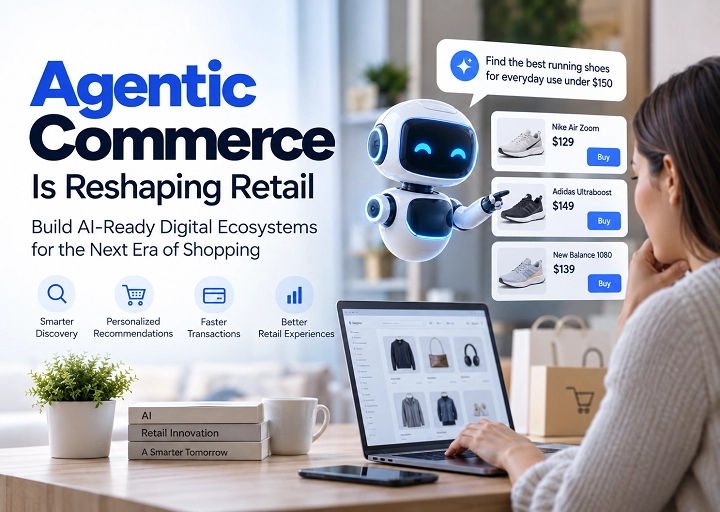
Traditional e-commerce relies heavily on customers navigating websites, searching catalogs, comparing products, entering information, and completing checkout themselves. Agentic Commerce introduces a more autonomous experience in which AI-powered agents can perform many of these activities on behalf of the consumer.
A shopper could simply tell an AI assistant what they need, their budget, preferred brand, required specifications, and delivery deadline. The AI agent could then evaluate available products, compare retailers, analyze fulfillment options, and recommend purchase-ready choices.
For retailers, this shift creates a new challenge: digital commerce platforms must be designed not only for human shoppers but also for the AI agents increasingly influencing their buying decisions.
What Is Agentic Commerce?
Agentic Commerce is an AI-driven commerce model in which autonomous or semi-autonomous AI agents perform shopping-related activities on behalf of consumers or businesses.
These activities can include:
- Product discovery
- Product comparison
- Price evaluation
- Inventory verification
- Personalized recommendations
- Promotion and loyalty analysis
- Shipping and fulfillment selection
- Payment authorization
- Order placement
- Post-purchase support
Unlike traditional conversational commerce, where an AI chatbot primarily answers questions, Agentic Commerce enables AI systems to take actions based on a user’s goals and defined permissions.
For example, a consumer could ask an AI assistant:
“Find me a lightweight business laptop under $1,500 that can arrive before Friday and has at least 16 GB of memory.”
Instead of returning a list of search results, an Agentic Commerce system could evaluate compatible products across participating retailers, compare pricing and delivery options, check inventory, and return the most relevant choices.
As AI assistants become integrated into everyday digital experiences, this type of intent-driven shopping could become an important part of the retail customer journey.
Why Agentic Commerce Matters for Retailers
Consumers increasingly expect digital experiences to be faster, more personalized, and easier to navigate.
Agentic Commerce can potentially remove several steps from the traditional buying journey by enabling customers to communicate their intent rather than manually navigating through numerous pages and filters.
For retailers, however, the shift changes how digital visibility works.
In traditional e-commerce, businesses compete for:
- Search engine rankings
- Website traffic
- Marketplace visibility
- Paid advertising placement
- Conversion rates
In an agent-driven commerce environment, another layer becomes important:
Will an AI agent understand, trust, recommend, and transact with your retail systems?
A retailer may have an attractive website and strong search visibility, but if its product data is incomplete, inventory information is outdated, APIs are inaccessible, or promotions cannot be interpreted by AI systems, its products may be difficult for autonomous agents to recommend.
The future of retail visibility may therefore depend on both human-facing experiences and machine-readable commerce infrastructure.
How Agentic Commerce Works
Agentic Commerce can involve interactions between a buyer agent representing the consumer and a seller agent representing the retailer or merchant.
Both systems perform different roles while working toward the same objective: helping the consumer find and purchase a suitable product.
Buyer Agents
A buyer agent acts as an intelligent digital representative of the customer.
Instead of requiring consumers to visit multiple websites, the buyer agent can interpret their requirements and search compatible commerce systems.
It may evaluate factors such as:
- Product specifications
- Pricing
- Customer ratings
- Availability
- Shipping speed
- Return policies
- Promotions
- Brand preferences
- Previous conversation context
If the customer has already specified a delivery deadline, preferred material, product size, brand, or budget, the AI agent can use that information when comparing products.
Large language models can process descriptions, structured product information, reviews, specifications, and other data to identify options that match the shopper’s intent.
Seller Agents
A seller agent operates on the retailer’s side of the transaction.
It can connect with systems such as:
- Product catalogs
- Product information management platforms
- Inventory systems
- Pricing engines
- Customer accounts
- Loyalty programs
- Promotion engines
- Payment services
- Order management platforms
- Fulfillment systems
When a buyer agent sends a request, the seller-side infrastructure can respond with structured information about relevant products, availability, pricing, delivery, and payment options.
The objective is to make retail information accessible in a format AI agents can reliably understand and act upon.
The Agentic Commerce Transaction Journey
A typical Agentic Commerce interaction can include several stages.
- Discovery
The buyer agent identifies retailers or seller systems capable of responding to the customer’s request.
- Product Query
Structured requests are sent to retrieve relevant products, specifications, pricing, availability, and other information.
- Comparison
The AI agent compares available choices against the customer’s requirements and preferences.
- Authentication
The customer’s identity may be verified before personalized information or account-related features can be accessed.
- Authorization
The system confirms permissions related to payment methods, spending limits, loyalty accounts, or other transaction requirements.
- Transaction Execution
Once the consumer approves the transaction, the purchase can be completed and confirmation returned to the AI assistant.
This model can substantially reduce friction compared with conventional e-commerce journeys.
Agentic Commerce Adoption
The Agentic Commerce ecosystem is developing rapidly, particularly, while retailers and technology companies are also exploring AI-powered shopping experiences.
Large retailers are experimenting with conversational product discovery, intelligent search, personalized recommendations, inventory visibility, and automated shopping assistance.
These developments demonstrate how AI could evolve from a recommendation tool into an active participant in the commerce journey.
The market presents additional opportunities and considerations.
Retailers operating across countries may need Agentic Commerce systems capable of handling:
- Multiple languages
- Different currencies
- Regional pricing
- Local payment methods
- Cross-border fulfillment
- Country-specific tax requirements
- Privacy and consent requirements
- Regional product availability
For international retailers, Agentic Commerce architecture therefore needs to support localization and regional compliance from the beginning.
Key Technology Challenges in Agentic Commerce
Most e-commerce infrastructure was built around human interaction.
Customers browse pages, view images, read descriptions, click buttons, and complete forms.
AI agents behave differently.
They depend heavily on structured data, APIs, real-time information, clearly defined relationships, and machine-interpretable business rules.
Retailers preparing for Agentic Commerce must address several technical challenges.
Product Data Must Become AI-Readable
Traditional product pages are typically designed to persuade human shoppers.
They rely heavily on photography, layouts, branding, promotional language, and visual context.
Humans can often understand incomplete information by interpreting surrounding content. AI systems require considerably more consistency.
An AI agent comparing products needs clearly defined information such as:
- Size
- Weight
- Material
- Compatibility
- Technical specifications
- Certifications
- Warranty
- Performance characteristics
- Availability
- Delivery requirements
Descriptions such as “premium quality” or “designed for performance” may appeal to customers but provide limited information to an AI system attempting to objectively compare products.
Retailers should therefore combine compelling marketing content with structured, measurable product attributes.
Real-Time Inventory Becomes Critical
Inventory accuracy is another important requirement for Agentic Commerce.
Many retailers still operate across fragmented systems involving warehouses, stores, distribution centers, marketplaces, and third-party fulfillment partners.
If inventory data is delayed, an AI agent could recommend a product that becomes unavailable by the time the customer attempts to purchase it.
For autonomous commerce experiences to work reliably, retailers need near real-time visibility into:
- Product availability
- Store-level inventory
- Warehouse inventory
- Delivery availability
- Fulfillment capacity
- Estimated shipping times
Reliable inventory information becomes particularly important when AI agents are making decisions within seconds.
Retail Architecture Must Become More API-First
Traditional websites are designed around pages and navigation.
Agentic Commerce requires retailers to think increasingly in terms of structured system-to-system communication.
AI agents should be able to retrieve product information without having to interpret every visual element of a website.
This makes technologies such as the following increasingly important:
- APIs
- Structured data
- Product schemas
- Metadata
- Taxonomies
- Knowledge graphs
- Standardized data models
The website remains important for customers, but the underlying commerce infrastructure must also become understandable to machines.
Fraud Detection Must Adapt to AI Agents
Another challenge involves fraud and bot detection.
Traditional security tools frequently evaluate human behavior such as:
- Mouse movements
- Page navigation
- Session duration
- Clicking patterns
- Browsing behavior
Authorized AI agents may display none of these signals.
Their interactions can be fast, structured, automated, and API-based.
Without appropriate controls, legitimate Agentic Commerce transactions could potentially be classified as suspicious automation.
Retailers therefore need security frameworks capable of differentiating trusted AI agents from malicious bots.
Identity verification, agent authorization, transaction permissions, payment security, and fraud prevention will become increasingly important components of Agentic Commerce infrastructure.
Preparing Your Business for Agentic Commerce
Retailers do not necessarily need to replace their entire technology stack to prepare for Agentic Commerce.
A structured, phased approach can help businesses identify the most important gaps and prioritize investments.
-
Conduct an Agentic Commerce Readiness Assessment
The first step should be evaluating whether existing systems are capable of supporting AI-led interactions.
An Agentic Commerce readiness assessment can examine areas such as:
- Product catalog quality
- Structured product information
- Inventory accuracy
- API accessibility
- Website architecture
- Payment infrastructure
- Loyalty systems
- Promotion engines
- Fraud prevention
- Customer identity systems
- Privacy and consent
- Content quality
- Performance and scalability
The objective is to understand where AI agents may experience difficulty discovering products, interpreting information, accessing inventory, or completing transactions.
For companies operating, the assessment should also consider regional data privacy requirements, localization, currencies, payment preferences, and cross-border commerce complexity.
-
Expand SEO Strategies for AI-Driven Discovery
Search engine optimization continues to play an essential role in digital commerce.
However, as AI-powered search and autonomous agents influence product discovery, retailers should also consider how their content is interpreted by generative AI platforms.
Traditional SEO focuses on helping search engines understand and rank webpages.
Agentic Commerce requires an additional layer of optimization focused on helping AI systems understand:
- What a product is
- Who the product is suitable for
- How it differs from alternatives
- What specifications it offers
- Whether it is available
- How much it costs
- What restrictions apply
- Whether it meets a customer’s requirements
Clear, factual, structured content becomes increasingly valuable.
Retailers should avoid relying entirely on vague promotional language and instead provide specific information that AI systems can interpret confidently.
-
Develop Machine-Readable Commerce Systems
AI agents need consistent and accessible information.
Retailers should therefore evaluate whether critical commerce systems can expose structured data through secure and scalable interfaces.
Product information should use consistent attributes and naming conventions.
For example, specifications for similar products should follow standardized formats rather than using different terminology across brands or categories.
Retailers may also benefit from improving:
- Metadata
- Product taxonomies
- Structured schemas
- API documentation
- Product relationships
- Compatibility information
- Real-time inventory feeds
The easier it is for AI systems to understand a retail catalog, the more effectively they can evaluate and recommend products.
-
Make Loyalty and Promotions Agent-Friendly
Retail promotions are often designed for visual discovery.
Customers may see banners, promotional codes, pop-ups, or membership offers while browsing a website.
AI agents need these benefits to be expressed through structured rules.
Instead of relying solely on messages such as:
“Buy one and get one free”
or
“Members save 15% today,”
the underlying system should expose eligibility, pricing conditions, discount rules, loyalty benefits, expiration dates, and exclusions in machine-readable formats.
This allows AI agents to accurately calculate the real value of an offer.
-
Modernize Payment and Identity Infrastructure
Payments are one of the most sensitive components of Agentic Commerce.
Retailers must provide convenient purchasing experiences while maintaining consumer control.
Agentic payment systems need strong mechanisms for:
- Customer authentication
- Transaction authorization
- Payment tokenization
- Spending permissions
- Fraud detection
- Consent
- Transaction auditing
Customers should remain aware of when purchases are being made and maintain control over the permissions granted to AI agents.
Trust will be essential for large-scale adoption.
-
Build Strategic Technology Partnerships
Developing an Agentic Commerce ecosystem requires expertise across several technology areas.
Retailers may need to collaborate with:
- AI technology providers
- Cloud infrastructure companies
- Payment platforms
- Identity providers
- Cybersecurity specialists
- Fraud prevention vendors
- Commerce platform providers
- Data engineering teams
The right partnerships can help companies adopt emerging standards while reducing the complexity of building every capability internally.
Agentic Commerce and the Future of E-Commerce
Agentic Commerce is unlikely to eliminate traditional websites or mobile applications.
Instead, it adds another interface through which consumers can interact with retail businesses.
Customers may continue to browse websites when they want inspiration or detailed research.
At other times, they may prefer to tell an AI assistant exactly what they need and allow the agent to perform most of the search and comparison process.
Retailers therefore need to support both experiences.
The future commerce ecosystem may serve two audiences simultaneously:
Human customers who browse and AI agents that discover, compare, and transact on their behalf.
That means user experience, SEO, product content, APIs, inventory management, payment infrastructure, security, and AI readiness must increasingly operate as part of one connected digital strategy.
Why Agentic Commerce Readiness Matters
As AI assistants become more deeply integrated into search, productivity tools, mobile devices, and digital platforms, consumers may increasingly use them as intermediaries between themselves and retailers.
When that happens, retailers will face an important question:
Can AI agents understand and transact with our business?
A company could have excellent products but still struggle to participate in Agentic Commerce if its digital infrastructure cannot communicate accurate information to AI systems.
Businesses that prepare early can improve their chances of being:
- Discovered by AI agents
- Accurately understood
- Included in product comparisons
- Recommended to suitable customers
- Selected during purchasing decisions
- Trusted during transactions
Retailers that remain dependent entirely on human-led browsing may gradually lose visibility as more product discovery moves into AI-driven environments.
Build an Agent-Ready Commerce Ecosystem
Agentic Commerce represents an important evolution in digital retail.
For businesses, becoming agent-ready requires more than adding AI features to an existing e-commerce website.
Retailers need connected digital ecosystems where product information, inventory, pricing, promotions, loyalty benefits, payments, fulfillment, APIs, and security systems can communicate accurately with AI agents.
The companies that succeed will combine strong customer experiences with infrastructure that is understandable and accessible to machines.
As AI agents increasingly influence product discovery, comparison, decision-making, and purchasing, retailers that begin preparing for Agentic Commerce today will be better positioned for the next phase of digital commerce.
The goal is not simply to build another sales channel.
It is to create a commerce environment where customers, retailers, and AI agents can interact securely, intelligently, and efficiently.
Frequently Asked Questions
What is Agentic Commerce?
Agentic Commerce is an AI-powered commerce model where autonomous or semi-autonomous AI agents help consumers discover, compare, select, and potentially purchase products based on their preferences and permissions.
How is Agentic Commerce different from traditional e-commerce?
Traditional e-commerce requires consumers to manually browse websites, compare products, and complete transactions. Agentic Commerce allows AI agents to perform many of these activities on the customer’s behalf.
How can retailers prepare for Agentic Commerce?
Retailers can begin by improving structured product data, real-time inventory visibility, APIs, machine-readable content, payment security, identity management, fraud detection, and AI-accessible loyalty and promotion systems.
Does Agentic Commerce replace SEO?
No. SEO remains important for traditional search visibility. However, businesses should also structure their content and commerce data so AI platforms and autonomous agents can accurately understand and recommend their products.
Why is structured data important for Agentic Commerce?
AI agents rely on accurate, structured information to compare products and make decisions. Clearly defined specifications, pricing, availability, compatibility, and fulfillment data can improve how effectively agents understand retail offerings.
Is Agentic Commerce relevant for retailers?
Yes. Retailers can benefit from Agentic Commerce, but implementations should account for regional requirements such as privacy, localization, multiple currencies, local payment methods, cross-border fulfillment, and country-specific commerce regulations.
What technologies support Agentic Commerce?
Agentic Commerce ecosystems may use AI agents, large language models, APIs, structured data, commerce platforms, inventory systems, identity technologies, payment infrastructure, fraud detection tools, cloud platforms, and real-time data services.