Innovate
  Accelerate
  Engineers & Experience
  Quality Assurance
  Salesforce
  Application Development and Maintenance
  Full Cycle Development
  Consulting Services
  Staff Augmentation
  eCommerce
  Education
  Fintech
  Health & Wellness
  Healthcare
  Logistics
  Media & Entertainment
  Real Estate
  Travel
  Sports




The Dawn of Conversational Robots
Imagine walking into a manufacturing facility and telling a robot, “Inspect the screws on this assembly line and identify anything outside tolerance.”
Instead of requiring new programming, the robot understands the request, identifies the components, performs the inspection, and reports what it finds.
This is becoming possible through the convergence of Large Language Models (LLMs), computer vision, robotics, sensors, and autonomous control systems.
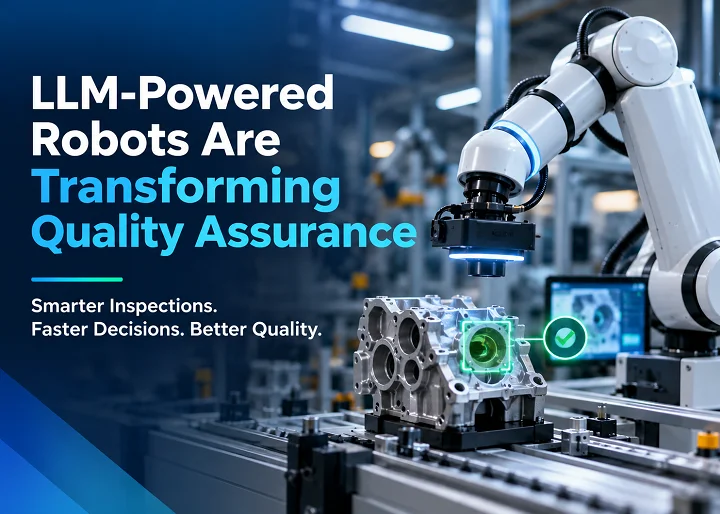
LLMs can interpret natural language and context. When connected to robotic systems, they can help translate human instructions into structured tasks. For manufacturers, this creates the potential for more adaptive and accessible quality assurance systems.
Rather than relying entirely on fixed instructions, LLM-powered robots can support inspection, defect analysis, reporting, and human-machine collaboration.
Breaking Down the Tech
Traditional robots are highly effective at repetitive, predefined tasks. They follow programmed rules and execute actions within carefully controlled environments.
LLM-powered robotics adds an intelligence layer.
A simplified workflow can look like:
Human instruction → Language understanding → Environmental perception → Task planning → Robotic action → Validation → Reporting
This allows operators to interact with robotic systems more naturally while still relying on dedicated control technologies for physical execution.
What Makes LLMs Special?
Large Language Models use transformer architectures and attention mechanisms to understand relationships within language and other contextual information.
Key capabilities include:
- Multi-head attention for identifying relationships across input data.
- Positional encoding for understanding sequence and structure.
- In-context learning for adapting to tasks through instructions and examples.
- Few-shot learning for handling tasks with limited examples.
- Zero-shot learning for attempting new tasks without dedicated training.
- Domain adaptation for learning industry-specific terminology and processes.
For quality assurance, these capabilities can help translate an instruction such as “inspect these welds for defects” into a structured inspection workflow.
Why Traditional Robots Fall Short
Traditional industrial robots generally depend on:
- Fixed control algorithms.
- Predefined sensor-to-action relationships.
- Manually configured workflows.
- Structured operating environments.
- Explicit exception-handling rules.
This works well when conditions remain predictable.
However, if production requirements change, objects move, lighting varies, or instructions become ambiguous, conventional systems may need additional programming.
LLM-enabled systems can add contextual understanding, helping robots interpret what an operator intends before passing the task to approved robotic control systems.
The Game-Changing Combination: LLM-Robot Integration Architecture
LLM-powered robotics combines language processing, perception, reasoning, and robotic execution.
Natural Language Processing Pipeline:
The process often begins with a spoken or written instruction.
Speech-to-text technology can convert audio into text, while an LLM identifies:
- Task intent.
- Target component.
- Location.
- Quality criteria.
- Operational constraints.
- Expected output.
This converts conversational instructions into structured machine-readable information.
Semantic-to-Action Translation:
A command such as “inspect the welding joints on the car doors” might be translated into:
- Task: Visual inspection.
- Target: Welding joints.
- Location: Car doors.
- Criteria: Joint integrity and surface condition.
- Output: Inspection result and defect report.
The translation layer helps prevent unrestricted natural-language commands from directly controlling machinery.
Robotic Control Integration:
The structured task is passed to robotic systems that may use:
- Motion-planning algorithms.
- Object detection.
- Pose estimation.
- RGB-D cameras.
- Force sensors.
- Real-time control loops.
- Safety controllers.
The LLM supports interpretation and planning, while dedicated robotic software manages physical execution.
Learning and Adaptation:
More advanced systems can use validated inspection results, operator feedback, and historical production data to improve future performance.
Previous successful workflows may be stored in databases or retrieval systems, allowing the AI to reference established procedures when similar conditions occur.
Revolutionary Impact on Quality Assurance
LLM-powered robots could make quality assurance more adaptive, scalable, and easier to manage.
Potential applications include:
- Automated visual inspection.
- Surface-defect detection.
- Weld inspection.
- Assembly verification.
- Quality report generation.
- Root-cause analysis.
- Predictive quality monitoring.
- Production-line inspection.
The biggest advantage is not simply automation. It is the ability to connect inspection results with contextual understanding and natural-language interaction.
The Current QA Challenge
Quality assurance involves more than identifying defective products.
Teams must understand why failures occur, document findings, compare results with standards, detect recurring trends, and determine when intervention is required.
Traditional QA processes may rely on:
- Repetitive human inspection.
- Static checklists.
- Manual documentation.
- Separate production and quality systems.
- Significant reprogramming when products change.
AI-powered robotics can help improve inspection coverage and consistency while allowing human specialists to focus on complex decisions.
How LLM-Powered Robots Transform QA
1.Multi-Modal Intelligent Inspection Systems
LLM-integrated systems can combine computer vision, sensors, and language intelligence.
Technologies may include:
- Vision-Language Models for connecting visual information with descriptions.
- Semantic segmentation for identifying precise regions.
- Defect-classification models for categorizing anomalies.
- Object detection for locating components.
- Natural-language reporting for presenting inspection findings.
Instead of showing only a defect code, the system could explain what was detected and where further review is required.
- Dynamic Quality Standard Adaptation
Manufacturers regularly introduce new products, components, suppliers, and specifications.
LLM-powered systems may support faster adaptation using:
- Few-shot learning.
- Prompt-based configuration.
- Retrieval-augmented generation.
- Knowledge graphs.
- Product specification databases.
Changes should still follow appropriate validation and approval processes, particularly in regulated environments.
- Predictive Analytics and Root Cause Analysis
AI can combine inspection findings with historical production information to identify recurring patterns.
Potential technologies include:
- Time-series analysis.
- Anomaly detection.
- Forecasting models.
- Autoencoders.
- Causal-analysis tools.
For example, the system could identify a relationship between changing machine temperatures and increasing defect rates, helping engineers investigate potential causes earlier.
4.Human-Robot Collaborative Interfaces
Natural-language interfaces can also make complex quality data easier to access.
Engineers might ask:
“Which production line had the most defects today?”
“Compare this batch with last week’s results.”
“Why was this component rejected?”
Systems can then retrieve data, generate summaries, display relevant findings, and escalate critical issues to human experts.
Real-World Implementation: Technical Case Studies
Research and industrial development are demonstrating how foundation models, machine vision, sensors, and robotic systems can operate together.
NVIDIA’s GR00T N1 and Blue Robot Architecture
NVIDIA’s work in embodied AI demonstrates how foundation models can be combined with simulation, perception, and robotic control.
A dual-system architecture is particularly relevant.
System 1 – Fast: Handles rapid, repetitive, and reactive robotic actions.
System 2 – Slow: Handles higher-level reasoning, interpretation, and planning.
The architecture can combine RGB-D cameras, force sensors, IMUs, and other sensor data.
This approach illustrates an important principle: large AI models do not need to control every robotic movement. They can focus on higher-level understanding while specialized systems manage time-sensitive execution.
Industrial QA Implementation: Automotive Case Study
An automotive quality environment could combine robotic arms, machine vision, edge computing, and an LLM-based reasoning layer.
Hardware Configuration:
Typical components may include:
- Industrial robotic arms.
- High-resolution vision systems.
- Depth sensors.
- GPU-enabled edge computers.
- Distributed production sensors.
Software Architecture:
A supporting software stack could include:
Perception Pipeline: Computer vision models identify components and defects.
LLM Integration: A domain-adapted model interprets instructions and quality requirements.
Quality Database: A graph database connects defects, causes, components, and corrective actions.
Control Systems: Robotic middleware coordinates approved machine actions.
Performance Metrics:
The source case study reported high defect-detection accuracy, a low false-positive rate, improved inspection throughput, and faster adaptation to new products.
However, such results should be treated as implementation-specific rather than universal benchmarks.
Actual performance depends on training data, defect complexity, environmental conditions, camera setup, validation methods, and system architecture.
Technical Implementation and ROI Analysis
Deploying AI-powered robotic QA requires investment across hardware, AI infrastructure, integration, safety, security, and operations.
Computational Requirements and Optimization:
Organizations may use:
- Model quantization.
- GPU acceleration.
- Edge inference.
- Distributed processing.
- Model pruning.
- Memory optimization.
Architecture choices should balance accuracy, latency, cost, availability, and data security.
Cost-Benefit Analysis:
Potential financial benefits include:
- Lower repetitive inspection costs.
- Reduced scrap and rework.
- Improved throughput.
- Faster product changeovers.
- Better defect traceability.
- Earlier identification of quality problems.
A practical ROI model should consider labor savings, avoided defects, productivity gains, infrastructure costs, maintenance, integration, and model validation.
Integration Challenges and Solutions:
Robotic QA systems may need to integrate with:
- ERP platforms.
- Manufacturing Execution Systems.
- Quality Management Systems.
- IoT infrastructure.
- Product Lifecycle Management platforms.
- Existing robotic controllers.
Cybersecurity, network reliability, API compatibility, and compliance requirements should be addressed early in the project.
Technical Challenges and Risk Mitigation
LLM-powered robotics creates new risks, including:
- Misinterpreted instructions.
- AI hallucinations.
- Sensor failures.
- Model drift.
- Unauthorized access.
- Incorrect quality decisions.
Industrial implementations should therefore use safety-constrained architectures rather than allowing unrestricted AI outputs to control physical systems.
Safety-Critical System Design
Important safeguards include:
- Emergency stops.
- Collision detection.
- Speed and force limits.
- Software constraints.
- Human approval checkpoints.
- Confidence thresholds.
- Fail-safe behaviors.
When confidence is low, the system should escalate the decision for additional inspection or human review.
Addressing LLM Limitations in Industrial Contexts
LLMs can generate incorrect information, so industrial systems need additional controls.
Hallucination Mitigation: Use retrieval-augmented generation and approved knowledge sources.
Domain Adaptation: Train or configure systems using relevant industrial terminology and data.
Temporal Consistency: Continuously monitor performance and model drift.
Robustness to Input Variations: Account for noise, accents, incomplete instructions, and technical jargon.
Future Research Directions and Emerging Technologies
Future robotic QA platforms are likely to become more multimodal, adaptive, and connected.
They may increasingly combine language, video, sensor data, production history, and robotic actions within unified AI architectures.
Advanced AI Architectures:
Important developments include:
- Multimodal Foundation Models: Combining language, vision, sensor data, and actions.
- Federated Learning: Allowing systems to learn across locations while protecting sensitive data.
- Continual Learning: Helping robots acquire new capabilities over time.
- Neurosymbolic AI: Combining neural networks with structured rules for better explainability and reliability.
Conclusion
The integration of Large Language Models with robotics represents an important evolution in industrial automation.
Traditional robots provide precision and repeatability. LLMs introduce language understanding, contextual reasoning, and more natural interaction.
Together with computer vision, sensors, edge computing, and controlled robotic systems, these technologies can help manufacturers create more flexible and intelligent quality assurance workflows.
Architectural Innovation:
The strongest architecture assigns each technology the role it performs best.
LLMs interpret intent and context. Vision systems analyze the physical environment. Specialized algorithms identify defects. Robotic controllers manage safe movement. Human experts remain responsible for critical and ambiguous decisions.
For organizations considering LLM-powered robotic QA, the most effective starting point is a clearly defined operational problem.
Identify an inspection bottleneck, establish measurable baseline metrics, evaluate available data, define safety requirements, and test the solution within a controlled environment before expanding deployment.
With the right architecture and governance, conversational robotics can move beyond experimentation and become a practical tool for improving quality, efficiency, scalability, and decision-making across modern manufacturing.