Innovate
  Accelerate
  Engineers & Experience
  Quality Assurance
  Salesforce
  Application Development and Maintenance
  Full Cycle Development
  Consulting Services
  Staff Augmentation
  eCommerce
  Education
  Fintech
  Health & Wellness
  Healthcare
  Logistics
  Media & Entertainment
  Real Estate
  Travel
  Sports




The world is changing the industries, whether in healthcare or transportation, with the advancement of artificial intelligence (AI). It has found its way into our lives, almost in every aspect: in our smartphones, cars, home assistants, and even in our own entertainment systems. It should not be surprising that, with AI being so deeply integrated into the system of contemporary technologies, it also causes a splash in the video game industry. Video games are yet to make all the possibilities of AI come true, but major improvements are made every day. The consensus in the gaming market is a significant change, which will be facilitated by AI implementation. Having a player base of more than 2.6 billion around the world, coupled with a market of 160 billion, AI will transform the appearance of games, attitude, and gameplay.
In this blog, we will discuss the current application of AI in video games and how it can develop in the future. We will also explore the opportunities that can emerge with the gaming world getting increasingly dependent on AI-driven technologies.
Video Game AI: Today and Beyond
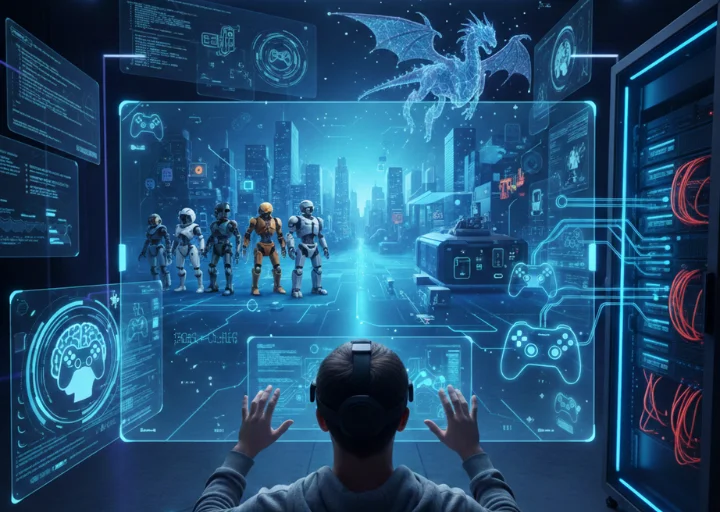
Although it may seem that video games, such as Minecraft, Grand Theft Auto, and God of War, contain high-level AI, the technology at the heart of these games shares the same principles as the simplest games of the past, including pathfinding, as seen in games like Snake and Pac-Man. Even the technology used today in the games, despite the impression of sophisticated appearance, is the same type of behaviour as an if-then-based algorithm—the ability to react to a particular trigger, such as an enemy attacking you in their line of sight, or even a computer game automatically raising or lowering game difficulty with your skill advancement.
These artificial intelligence platforms do not learn on their own; they are programmed to move in certain ways and produce certain results. This implies that the games may appear complicated, but the AI in these games cannot learn new actions or strategies; it can only execute what the programmer programmed it to do. This solution removes the degree to which the AI may affect gameplay in contemporary games, since the developers want to retain the level of predictability for the players. Nevertheless, with the development of technology, new possibilities of AI in the world of gaming emerge, and it would be possible to create games that will learn and evolve with the players.
AI-Powered Graphics and Opponents
Enhancing Computer Graphics
In the current games, AI is making a significant contribution to the level of graphics. A notable use is to use it to improve the visuals by means of real-time ray tracing. This technology brings out real lighting, shadows, and reflections, which make the game surroundings appear real. The game, such as Grand Theft Auto V, shows that AI speeds up every detail of the scene, including how smooth the asphalt is and how vehicles are reflected in the roads and machines, engulfing the gamer in truly gorgeous real-world settings.
Creating Smart Opponents
AI is also in use because it is designed to produce intelligent, responsive antagonists that can be used to challenge the players. Historically, NPCs in games were only able to act in a certain way; with AI, they have the opportunity to act more complexly depending on the actions of the players in real time. But with the inception of multiplayer gaming, AI-controlled rivals have given place to actual players, who now control the online gaming scene. The increased application of AI in multiplayer experiences is aimed not at using AI-controlled opponents but at the player experience and interaction. Although AI in all its opponents may not be the focus at the moment, the future promises to be an exciting one with smarter and more adaptable NPCs.
Looking to the Future with GANs
One of the most promising AI teams in the gaming industry is the Generative Adversarial Networks (GANs). GANs can produce absolutely new and original game content by competing with neural networks. GANs may be used to generate more lifelike textures, generate new game content, or even design new rules and mechanics, and ensure that games stay fresh and exciting. Dynamically evolving games might be opened by this capability to generate unique content in real-time to provide the player with experiences never seen before.
The potential of GANs is enormous: a game where the AI is constantly generating new environments, challenges, and even plots based on the interaction of the player with the game. Eric Nesser, a global director of 3-D and interactive at a multinational advertising firm, was interviewed on the topic, justifying the idea of working with GANs as collaboration with a mind of its own when forming unpredictable but interesting outcomes. It might be the future of game design, where AI not only complements human creativity but also drives it.
Billions of Gamers = Millions of Jobs
It is not only that the global gaming community is redefining entertainment, but it is also providing new employment opportunities. In his TED Talk about the transformative power of video games, Herman Narula points out that the huge number of players around the world has resulted in technological innovations that will cause the creation of jobs in several fields. The gaming industry is already an extensive source of employment, from the development and engineering of a game to the creation of a story or the design of artwork, marketing the product, and any other area related to the gaming industry.
Millions of jobs are opened up as a result of the number of people joining the gaming ecosystem. According to Narula, it might be a good opportunity in the gaming industry to create a source of income among the younger generations much earlier; research and development, as well as content creation, are potential opportunities. As gaming continues to expand at an alarming rate, its potential as a source of employment is huge.
Is AI Solving the Right Problem?
Although AI is definitely also improving the gaming industry, it is also employed in original applications of solving real-world issues. Firms such as DeepMind and OpenAI are using video games to ensure AI is able to learn and better solve the problem. Through playing games, AI can take a new approach to gaming and perfect its decision-making models in a controlled setting and then implement them on real-life problems.
As an example, DeepMind has employed reinforcement learning, a type of machine learning that has experimental properties in which an AI learns by trial and error and which is the one that can then learn simple games such as Pong and then more advanced games such as Dota 2 and StarCraft II. These capabilities of AI in industries such as manufacturing and autonomous driving are meant to be transferred eventually.
As much as some people believe the possibility of AI in games turning unpredictable, scientists such as Janelle Shane can help us reconsider this fear. Instead of worrying about the possible risks of AI being unpredictable, one should consider providing AI with challenges to solve. According to her, the success of AI in gaming is an essential move on the way to making the process of solving real-world problems more efficient and innovative.
Explore the Future of AI in Video Games
With AI still defining the future of video games, it is also defining the future of other industries other than games. Engineering has an online AI executive certificate course that supports the use of AI power by business leaders. The program will make learners knowledgeable and skilled in applying AI to new product development, operational optimization, and industry disruption, such as in gaming.
The AI executive education program will be based on the foundations of AI, such as the design and analysis of efficient algorithms, neural networks, and deep learning, as well as the use of AI in industries. The participants will also investigate such challenges as security, privacy, and data mining, and learn the legal and social implications of AI. This program combines theoretical and practical knowledge to equip business leaders with the possibilities of AI in a way that could make it be considered innovative, creative, and transformational.
With the further development of AI, the possibilities in video games and more are limitless. The acceleration of the video games ahead is where AI will not just improve the graphics and in-game mechanics but also generate new realities, virtual and real. Under the supervision of AI, the future of gaming will become more interactive, intelligent, and lively like never before.