
 Innovate
  Accelerate
  Engineers & Experience
  Quality Assurance
  Salesforce
  Application Development and Maintenance
  Full Cycle Development
  Consulting Services
  Staff Augmentation
  eCommerce
  Education
  Fintech
  Health & Wellness
  Healthcare
  Logistics
  Media & Entertainment
  Real Estate
  Travel
  Sports




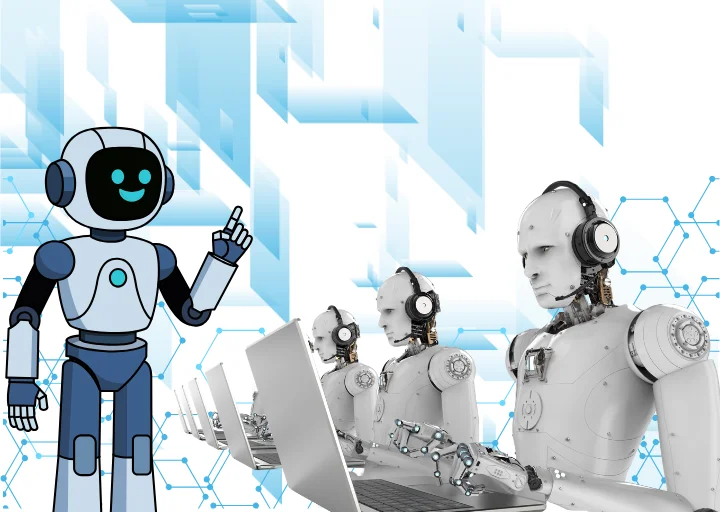
However, robotics is entering a new era in which the rate of progress is no longer measured in terms of speed, precision, or cost savings. Instead, the conversation is about intelligence, flexibility, and security, and the role that robots are playing in helping to solve business and workforce problems. As industrial robots continue to set market value at an all-time high, the path forward is being driven by an array of technologies, operational demands, and workforce realities. These are not isolated events; they are having an impact on the world in terms of manufacturing, logistics, warehouse, and service environments.
International Federation of Robotics Reports
Frankfurt, Jan 08, 2026-The global market value associated with the installation of industrial robots has now risen to a record high of 16.7 billion USD. Looking forward, future demand will be influenced by technological advancements, market factors, and increasing commercial uses. The International Federation of Robotics has recognized five major trends that will characterize the robotics industry in 2026.
1 – AI & Autonomy in Robotics
One of the most powerful influences in the development of robotics comes from artificial intelligence. More robots are now being built with the capacity to perform tasks with more independence, thus requiring less human intervention. The greatest advantage that AI has to offer in robotics comes from its capacity to enhance independence in robots, enabling them to evaluate situations, make choices, and act more flexibly.
Several types of artificial intelligence exist, and one of the most important ones in robotics comes in the form of analytical AI. Analytical AI has been critical in assisting robots in gathering large amounts of data, which enables them to identify patterns and generate useful insights. In industrial settings, this has been critical in assisting robots in identifying possible failures before they cause disruptions in production.
However, generative AI is taking the industry even further in this direction. This means that, rather than simply relying on sets of rules, robots can use generative AI to create new content and even change how they behave. This allows them to learn new, unfamiliar tasks, create synthetic data through simulated learning, and even improve how they interact with humans. For example, natural language and vision-based commands are allowing robots to become much more accessible and even easier to use, and this has huge potential to improve human-robot collaboration.
One other important development in AI and its use in robots has been the emergence of agentic AI. This approach seeks to use a combination of analytical AI, through its use of rules, and generative AI, through its ability to change and improve how a robot behaves, to enable robots to behave more independently in a world that is often unpredictable and even complex. As robotics continues to improve, AI remains a core part of developing robots that are not just automated but even adaptive.
2 – Robots gain versatility as IT meets OT
The need for flexible and efficient robots is rising rapidly, and the driving force behind the rising need is the integration of information technology and operational technology. Traditionally, information technology has been all about data, software, and digital technologies, while operational technology has been all about machines, control systems, and physical operations. The integration of these two technologies has led to the enhancement of the capabilities of robots.
The integration has led to the free flow of data from one digital platform to another, while the robots are able to respond to physical operations in real-time, all while enjoying the benefits of analytics, cloud, and software capabilities. This has led to the creation of a new kind of dynamic automation, which can respond better to changing operations, disruptions, and customer needs.
For businesses looking to develop digital businesses and Industry 4.0, this integration is an important part of the process. It eliminates the traditional barriers that existed between departments and technologies, creating a more unified system through which the robots can function and perform. Rather than being unidimensional and only being able to perform one task, robots are now being designed to be more multidimensional and able to perform multiple functions.
As the distinction between digital and physical continues to blur, the expectation is that companies will invest more heavily in robotics technologies that are able to communicate and perform with more operational agility.
3 – Humanoids to prove reliability and efficiency
Humanoid robotics is becoming an increasingly popular concept, especially within industries where it is expected for machinery to be utilized within spaces designed for human interaction. Humanoid robots have been viewed as an answer to industries where flexibility, mobility, and human interaction are considered essential. While automotive industries have been at the forefront of this movement, interest is beginning to emerge within warehousing and manufacturing operations globally.
The industry is no longer just experimenting with humanoid robots. Rather, they are increasingly considering how they can utilize them in the real world, rather than just looking at them as possibilities in the future. While this is an exciting prospect, it is also a high bar for them to be able to reach.
However, in order for humanoid robots to make an impact in the marketplace, they must be able to show that they are reliable. This is because they are expected to be able to compete with other automation technologies, which means they must provide a strong performance, moderate energy consumption, and low maintenance costs. Reliability is no longer a luxury but a necessity. This is one of the most important considerations when considering whether or not humanoid robots will be able to make an impact in the factory.
Another important requirement, however, is efficiency. This is due to the fact that, in light of a looming labor shortage, humanoid robots are expected to portray human-like efficiency and productivity. Another aspect being considered in the discussion of humanoid robots is the aspect related to the industry standards. However, the challenge currently facing humanoid robots is not the ability to portray impressive performances, but rather the ability to cope with the demands of the factory.
4 – Safety and Security in Robotics
This is particularly important as robots become more integrated into work teams. The increased use of AI-driven autonomy has made safety more complicated, particularly because robots are now making more decisions autonomously.
The issue of safety has been made more prominent with humanoid robots, particularly because they are meant to be integrated into spaces where there will be human interaction. The development and deployment of robots have to be carried out in a manner that meets ISO safety standards, and there has to be a clear structure in place in terms of liabilities, or the risks associated with deployment will be much harder to manage.
Security is another significant concern that is also raised. As robotics becomes increasingly integrated into AI, cloud computing, and connected operational systems, the risks associated with cyber attacks also become a concern. Experts have noted that there is an increased number of hacking attempts targeting robot controllers and cloud computing systems, which may potentially allow for the manipulation of robotics systems.
There are also emerging concerns regarding data privacy. As robots are increasingly used in modern workplaces, there is a potential for collecting video, audio, and sensor-based data, including sensitive information. Additionally, deep learning is also a concern, as these systems are often opaque and make it difficult to interpret and explain the results. This is a concern, especially when determining liability after an incident. To ensure that robotics is effectively rolled out, security and accountability are crucial.
5 – Robots as allies in tackling labor gaps
Labor shortages have been seen to be an issue, especially for industries where labor is required for a particular task. This has seen various industries struggle in providing the required labor for the tasks at hand, leading to an increase in workload for the existing labor and, hence, an increase in stress levels. Robotics was seen as a possible solution to the problems facing the labor force at the moment.
Contrary to the traditional view of robots replacing human labor, it was seen to be an aid to human labor, which can perform tasks considered to be repetitive, physically taxing, or boring, thus allowing human labor to be utilized for tasks considered taxing in other ways, such as tasks that require judgment, creativity, or social skills, thus making the working environment more sustainable, either in a manufacturing environment or a service-based environment.
However, for this to be possible, it is important to ensure that the workers are comfortable with the system. It is possible for an organization to be able to create trust among the workers and ensure that they cooperate with the robots by realizing that they can also benefit from the robots.
It is also possible for robotics to be beneficial to industries, especially for those that need to change the image of the industry. The governments and industries are also realizing the need to reskill and upskill the employees to ensure that they are able to cope with the demands that are changing. It is important to realize that the robots are not just for automation but also for helping the industry cope with the shortage of labor.

Comments are closed.
1 Comment-
Pingback: Types of AI for Small Businesses: Examples, Benefits & Use Cases