
 Innovate
  Accelerate
  Engineers & Experience
  Quality Assurance
  Salesforce
  Application Development and Maintenance
  Full Cycle Development
  Consulting Services
  Staff Augmentation
  eCommerce
  Education
  Fintech
  Health & Wellness
  Healthcare
  Logistics
  Media & Entertainment
  Real Estate
  Travel
  Sports




Creating a mobile app is thrilling, but invariably the initial question that arises is, “How much will it cost?” From starting up a new business idea to planning digital expansion, or even an established brand looking to enhance customer engagement, the cost of app development is a significant factor in the decision-making process.
The reality is that it’s not a one-size-fits-all app development cost. A straightforward mobile app with a basic interface and functionality will cost significantly less than an AI-powered, real-time tracking, payment system, augmented reality, or high-tech backend application. The final budget is going to rely on the objective, features, design complexity, technology stack, strategy of development, location of the development team, and the future maintenance needs of the app.
There’s another big question that many businesses have to take into account: Should they use an app development company or build the app in-house? Either can be possible, but each has various pros and cons as well as various costs.
A professional app development company typically has all of the following in existence under its roof: experienced personnel, processes, technical experts, designers, quality assurance professionals, and project managers. This may help minimize expensive errors and accelerate the delivery process. However, hiring a in-house would seem more budget-friendly in the beginning but they come with higher costs due to recruitment, salary, training, delays, and rework.
Every mobile app project is different, so the easiest way to learn about your budget is to check out the big cost factors, industry averages, development phases, calculator, hiring costs, and maintenance costs. The guide clearly explains each element, helping businesses plan better and reduce financial shocks.
App Development Cost Influential Factors
Several factors directly shape the cost of building a mobile app. Understanding these elements helps businesses estimate a realistic budget before development begins.
App functionality and purpose – The more an app needs to do, the more time and resources it requires. A simple informational app may only need basic screens, while a marketplace, fintech platform, ride-booking app, or healthcare solution may require complex workflows, user roles, payment systems, notifications, and admin controls.
Mobile platforms and supported devices – Developing for iOS, Android, or both affects the budget. Businesses must also consider device compatibility, screen sizes, operating system versions, and hardware differences across smartphones and tablets.
Integration points – Many apps rely on third-party services such as payment gateways, maps, CRMs, analytics tools, social login, cloud storage, chat systems, or external APIs. Each integration adds planning, development, testing, and maintenance work.
Use of visual objects – Apps with custom animations, interactive graphics, advanced dashboards, 3D elements, or rich visual experiences generally cost more than apps with standard layouts and simple screens.
Use of smartphone hardware features – Features such as GPS navigation, camera access, NFC, biometric authentication, motion sensors, augmented reality, Bluetooth, or push notifications can increase development complexity.
Maintenance plan – App development does not end after launch. Updates, bug fixes, security patches, performance improvements, and new feature releases must be included in the long-term budget.
App Development Price Benchmarks
Although app pricing varies widely, businesses can use general benchmarks to set early expectations.
- Simple app development price tag: $5,000 – $25,000
- Medium-complexity app development price tag: $25,000 – $70,000
- Complex app development price tag: $70,000 – $100,000
- Cost of hiring a U.S. app developer: around $100,000 – $133,000 per year
A simple app may include login, user profiles, basic content, forms, and limited backend functionality. A medium-complexity app may include payments, API integrations, dashboards, admin panels, chat, booking, or moderate automation. A complex app may involve artificial intelligence, blockchain, IoT, live streaming, real-time tracking, advanced analytics, multi-role access, or enterprise-grade security.
These figures are helpful for early planning, but they should not replace a detailed estimate based on scope, features, timeline, and technical requirements.
App Development Cost Benchmarks
The cost difference between iOS and Android development was once more noticeable. Today, the pricing is often similar because both platforms require professional planning, design, coding, testing, and deployment. The biggest cost driver is no longer simply the operating system; it is the complexity of the app.
A simple app usually takes around two to four months to develop. A mid-level app may take four to six months. A complex app can take nine months or more, especially when it includes custom backend systems, advanced integrations, multiple user roles, or high-level security requirements.
Team productivity also affects the timeline. A well-managed team with clear documentation, fast communication, and strong technical leadership can complete work more efficiently. Poor coordination, unclear requirements, and frequent scope changes can extend the timeline and increase costs.
In the United States, app development hourly rates often average around $20 per hour. Based on this, a basic app may cost between $5,000 and $25,000; a medium-complexity app may fall between $25,000 and $70,000; and a complex application may require a budget that reaches $100,000 or more depending on the scope.
App Development Cost [stages]
A mobile application budget typically goes through various stages of development. All the phases are crucial in the process of transforming an idea into a working, scalable, and commercial product.
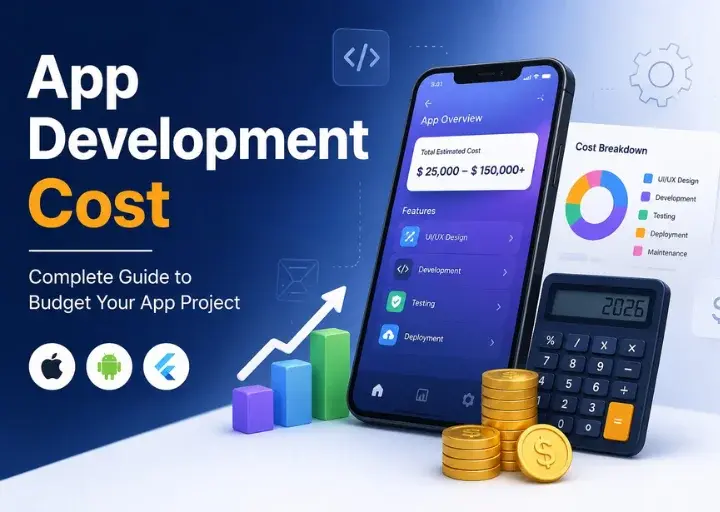
The discovery stage is an estimated 10%-15% of the total budget. This phase involves business analysis, market research, requirement gathering, competitive analysis, user journey mapping, feature prioritization, and project scoping. A good discovery phase is useful to decrease confusion during development.
The designing stage comprises around 20% – 25% of the overall budget. Designing includes some features of wireframes, user interface/user experience design, clickable prototypes, visual design systems, and user experience planning. Good design is not only good looking but also allows easy task accomplishment by the users and makes the product usage more engaging.
Development usually takes up 40% to 55% of the total budget and thus becomes the most expensive stage of the project. Developers create front end, back end, databases, API, admin panel, integrations, and the whole logic of the app here. The more complex the feature you want, the more development will be needed, therefore real-time updates, payment gateway, artificial intelligence, and geolocation can increase development expenses.
Typically, testing and quality assurance take 15% – 20% of the budget. QA teams take the app on various devices, screen sizes, various operating systems, and different network and user scenarios. This covers functional testing, regression testing, performance testing, usability testing, and security testing.
The percentage of total budget that needs to be allocated to deployment is 5% to 10%. This entails preparing the app for the Apple App Store and Google Play Store, setting up servers, managing release builds and troubleshooting launch problems, and planning for early updates.
App Development Cost Calculators
Since estimating the cost of developing mobile applications is often complicated, especially without technical expertise, some organizations have created cost calculators available online. The cost calculators allow businesses to calculate their budgets by asking various queries about the application.
These cost calculators are quite useful when doing preliminary planning; however, one must remember that these cost calculators only serve as guidelines.
Cleveroad calculator
The Cleveroad calculator provides users with the option to answer a set of questions that will help in estimating the cost of app development. Businesses are provided with the option to choose from building an app that is somewhat like some other platform app, for example, Uber, Snapchat, Airbnb, or to build something entirely different.
With the addition of features by users, the calculator provides an estimation of time required for development in hours.
Buildfire calculator
The Buildfire calculator utilizes a step-by-step approach in estimating app prices. There are various elements that are taken into account including the platform, features, users, integration, monetization, maintenance, hosting, and related services development.
This approach enables business owners to understand how their decisions affect the estimate.
Estimate My App calculator
The Estimate My App website employs a single-page design that allows the users to choose several filters simultaneously. The filters involve aspects such as size of the app, interface, accounts, user generated content, mobile app specific features, location based features, social features, billing, ecommerce, analytics, APIs, and security.
The calculator will assist the users who want to estimate several feature categories simultaneously.
Inoxoft calculator
The Inoxoft calculator helps to calculate expenses both for desktop and mobile software solutions. The difference from other calculators consists in providing ranges of prices for every stage of calculation, whereas others offer just one final result.
In such a way, businesses get more information on how their decisions influence the budget estimation process.
How Much to Make an App
The “How Much to Make an App” price calculator uses an eight step approach. Users get a rough estimate while completing the calculations, and finally, they can enter their contact details to complete the process and take the project further.
This calculator comes handy for companies which need a proper estimation before contacting any development provider.
Andreasley calculator
Andreasley employs a cart-like system in its price calculator. While selecting the options, the estimated price is displayed aside, just as items are displayed in a shopping cart.
The calculator takes into account the platform, the level of quality, number of screens, custom controls, types of devices, orientation of screens, security, operating system version support, languages, deployment requirements, and special features like in-app payments, statistics, and push notifications.
Litslink calculator
The Litslink calculator guides users step by step through the set of questions starting from the industry for which the application is developed. Moreover, it gives a summary of selected options, enabling companies to evaluate their needs prior to submitting the estimate request.
After completion of the process, users will be able to submit a contact form to get a more accurate estimate of development costs.
Digitalya calculator
The Digitalya calculator follows a five-stage procedure that helps you get estimates of your app development budget and time frame. You are allowed to decide whether you need a web app, mobile app, or both.
You will also receive estimates for the user profile, MVP features, revenue model, and even advanced technologies like AI, IoT, virtual reality, and augmented reality. The estimate is also available in PDF format.
Cost of Hiring App Developer
Directly hiring mobile app developers is another strategy that businesses could adopt, although it might suit those companies which would like to have long-term control over the process of development inside their organization. Hiring involves having your own cost model, however.
For instance, in the United States the cost of hiring one mobile app developer per year is approximately $110,000. In the United Kingdom it might be about $85,000 and in France – about $70,000. In India the cost would be notably lower – about $12,000 per year. This is due to the fact that different regions have different salary expectations.
However, salary should not be the only criterion for evaluation. The company should consider such factors as experience, quality of portfolio, technical skills, communication skills, managing deadlines, solving problems and client reviews.
Lower hourly rate does not necessarily mean lower cost overall. Lack of experience or poor quality of a product will eventually require fixing bugs, re-design, re-development and delays on your part.
App Maintenance Cost
Mobile application maintenance is an ongoing expense. After the launch of the mobile application, it needs to be kept secure, working, compatible, and user-friendly. It is often observed that on an average basis, maintenance expense is about 15%-25% of the initial development cost.
Application maintenance includes bug fixing, security update, performance testing, API update, platform compatibility, backend support, user feedback, UI/UX update, database management, and software subscriptions.
Bug fixing and updates
An application that is properly developed will also require some bug fixes upon release. There will be problems on certain devices, operating systems, or even network configurations. Updates ensure that users have an improved experience.
Cost of annual bug fixes and updates could be anywhere from $1,000 to $5,000.
Security updates
Security should be regarded as an ongoing concern. Applications deal with personal information of users, credit card details, passwords, location information, or corporate data.
The process of providing security updates involves fixing security issues, improving the authentication process, upgrading the libraries, threat tracking, and compliance with platform security guidelines. The annual cost for security updates could be in the range of $1,000 to $2,500 or higher.
Performance monitoring
It is essential for a mobile application to have fast loading time and smooth operation. The performance monitoring system will enable you to monitor crashes, lagging screens, server reaction, user activity, and errors.
The tools like Google Analytics, New Relic, App Dynamics, and others can be monthly or annually paid. Performance monitoring could cost from $2,400 to $24,000 per year based on the scale of the app.
Third-Party API maintenance
There are applications which use the third party API to conduct transactions, display maps, send messages, carry out analysis, deliver parcels, integrate with social media, and even access third party data.
Maintenance of an API involves checking updates, implementing necessary changes, installing patches, revising the documentation, and dealing with any compatibility issues. This is estimated to cost between $3,000 and $20,000 per year.
Platform updates
Apple and Google regularly update iOS and Android. These updates may affect app performance, permissions, design standards, security requirements, and app store guidelines.
Developers must update the app code to remain compatible with the latest platform changes. Annual platform update costs may range from $5,000 to $30,000 depending on the app’s complexity.
Server and backend maintenance
Apps that rely on user accounts, databases, payments, content, notifications, or real-time features need backend infrastructure. Server and backend maintenance ensures reliability, scalability, performance, and secure data handling.
This may include server monitoring, database optimization, backups, cloud infrastructure management, uptime checks, and backend security updates. Annual costs may range from $5,000 to $25,000.
User support and feedback
User support is essential for improving retention and trust. Businesses must respond to complaints, technical issues, feature requests, and usability concerns.
Support and feedback management may include helpdesk tools, customer support staff, app store review monitoring, and product improvement planning. Annual costs may range from $2,000 to $10,000.
Design and UX / UI updates
User expectations change quickly. An app that looked modern two years ago may start to feel outdated if it is not refreshed.
Design and UX/UI updates may include improving navigation, redesigning screens, updating buttons, enhancing accessibility, simplifying user flows, and adopting newer design practices. Annual costs may range from $5,000 to $25,000.
Database management
Database management keeps app data organized, secure, and accessible. It includes backups, data cleanup, performance tuning, storage optimization, access control, and database updates.
For apps that handle large amounts of data, this is especially important. Annual database management costs may range from $5,000 to $15,000.
Licenses and subscriptions
Most apps rely on paid tools, frameworks, cloud services, SDKs, monitoring platforms, analytics tools, design systems, or third-party software. These recurring expenses must be included in the maintenance budget.
License and subscription costs may range from $1,000 to $10,000 per year depending on the app’s features and technology stack.
Final Thoughts
Estimating app development cost requires more than choosing a platform and listing features. Businesses must consider app complexity, development team location, design requirements, backend infrastructure, integrations, testing, deployment, and long-term maintenance.
For many companies, building for both iOS and Android is a smart strategy because both platforms have large user bases. Cross-platform development may also help reduce costs in some cases, depending on the app’s requirements.
The biggest expense often comes from infrastructure, backend development, integrations, and advanced features. Businesses can manage costs by starting with a clear MVP, prioritizing essential features, choosing scalable technologies, and planning maintenance from the beginning.
A realistic budget helps prevent delays, scope issues, and quality problems. Whether you hire an app development company, build an in-house team, or use a hybrid model, the best approach is to define your goals clearly, validate your core features, and invest in a solution that supports long-term growth.

Comments are closed.
1 Comment-
Pingback: Logistics Software Development Cost: Pricing & Budget Guide