Innovate
  Accelerate
  Engineers & Experience
  Quality Assurance
  Salesforce
  Application Development and Maintenance
  Full Cycle Development
  Consulting Services
  Staff Augmentation
  eCommerce
  Education
  Fintech
  Health & Wellness
  Healthcare
  Logistics
  Media & Entertainment
  Real Estate
  Travel
  Sports




Staff augmentation and outsourcing are two popular IT hiring models that help businesses access skilled professionals, reduce costs, and accelerate project delivery. While both approaches involve working with external talent, they operate in very different ways.
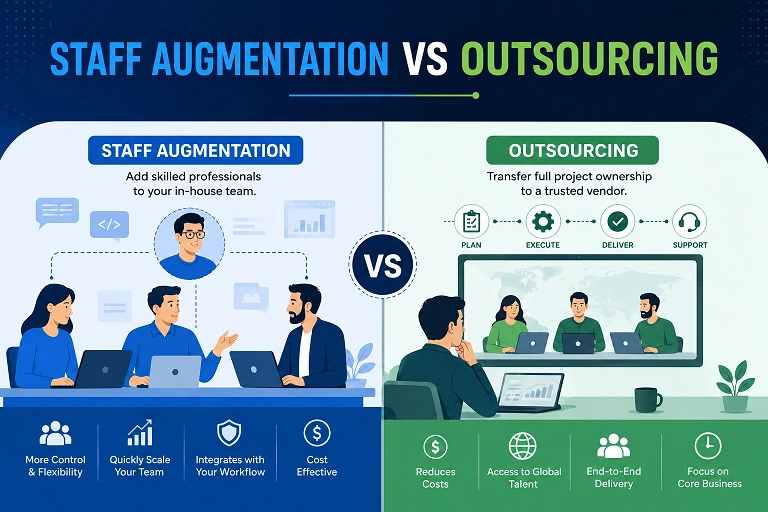
Staff augmentation allows companies to add experienced professionals to their existing in-house team while maintaining direct control over tasks, workflows, and project execution. Outsourcing, on the other hand, involves assigning an entire project or business function to a third-party vendor that manages planning, development, delivery, and overall execution.
As technology continues to evolve, businesses need flexible hiring strategies that help them scale faster without the challenges of traditional recruitment. Many companies now rely on external IT teams to manage short-term requirements, access niche expertise, and improve operational efficiency. This is why the debate around staff augmentation vs IT outsourcing has become increasingly important.
The IT staff augmentation market is projected to reach USD 857.2 billion by 2031, while the IT services outsourcing market is expected to grow to USD 1,219.31 billion by 2030. These numbers clearly show that both models are becoming essential for modern businesses.
However, choosing the right model depends on your project scope, budget, internal capabilities, management style, and long-term business goals. This guide explains the key differences between staff augmentation and outsourcing, along with their advantages, disadvantages, and best use cases.
What Is Staff Augmentation?
Staff augmentation is a flexible hiring model where businesses hire external IT professionals to work alongside their internal teams. These professionals are usually hired on a temporary, contractual, or project-based basis to fill specific skill gaps.
In this model, the company retains full control over the project, task assignment, workflow, communication, and performance management. The augmented professionals function as an extension of your in-house team and follow your company’s processes, tools, and coding standards.
Reliable IT staff augmentation companies help businesses connect with skilled developers, designers, QA engineers, project managers, and other technology experts from different regions. This allows companies to quickly increase team capacity without going through lengthy recruitment, onboarding, and retention processes.
Staff augmentation is especially useful when you already have an internal team but need additional expertise or manpower to meet deadlines, handle peak workloads, or work on specialized technologies.
Confused between augmenting your team or outsourcing?
Learn how each model impacts scalability, control, and project outcomes.
Advantages of Staff Augmentation
To better understand staff augmentation vs outsourcing, it is important to review the benefits of each model separately. Staff augmentation offers several advantages for businesses that want flexibility, control, and access to experienced professionals.
Increased Capacity
As your business grows, your development workload may increase faster than your internal team can handle. Staff augmentation helps you quickly add skilled professionals to your team without hiring full-time employees.
These professionals work alongside your existing team and increase your overall delivery capacity. Many companies use IT staff augmentation services during product launches, peak seasons, urgent deadlines, or large-scale development cycles.
This model allows businesses to scale their teams efficiently while avoiding the high costs and delays associated with traditional hiring.
No Commitments
One of the biggest advantages of staff augmentation is that it does not require long-term employment commitments. You can hire developers, designers, or QA professionals for a specific period and release them once the work is completed.
This makes staff augmentation ideal for short-term needs, temporary skill gaps, or project-based requirements. Businesses can increase or reduce team size based on demand without dealing with complex employment formalities.
It also gives companies the freedom to work with multiple service providers if they need different skill sets at different stages of the project.
Complete Control
Unlike outsourcing, staff augmentation gives businesses full control over resources and project execution. Even though the professionals are hired externally, they work as part of your team and follow your instructions.
You can assign tasks directly, monitor progress, manage priorities, and ensure that the work aligns with your internal standards. This level of control is useful for companies that want to maintain ownership of their product vision, architecture, development process, and quality standards.
Staff augmentation also allows you to align remote professionals with your preferred working hours, communication channels, and internal workflows.
Experienced Resources
Staff augmentation gives businesses access to experienced professionals who are comfortable working remotely and collaborating with distributed teams. These experts usually have strong technical knowledge, communication skills, and the ability to adapt to different work environments.
Since augmented staff often work across time zones and with various clients, they are usually flexible, independent, and capable of handling responsibilities with minimal supervision.
This makes them valuable for companies that need skilled professionals who can quickly understand project requirements and start contributing.
Flexibility
Staff augmentation offers a high level of flexibility in terms of working hours, technologies, engagement duration, and payment models.
You can hire professionals for full-time, part-time, hourly, or fixed-period engagements depending on your business needs. You can also scale the team up or down as your project requirements change.
This flexibility makes staff augmentation a practical option for startups, growing businesses, and enterprises that need to respond quickly to changing market demands.
Cost Effective
Staff augmentation can be a cost-effective alternative to hiring full-time employees. When you hire permanent employees, you must pay salaries, benefits, insurance, office expenses, training costs, and other employment-related expenses.
With staff augmentation, you can access skilled professionals at a lower cost, especially when hiring from regions with competitive development rates. This helps businesses reduce overhead while still getting high-quality work.
For long-term or recurring development needs, staff augmentation can offer significant cost savings compared to building a large in-house team.
Disadvantages of Staff Augmentation
Like any hiring model, staff augmentation also has certain limitations. Understanding these drawbacks is important before choosing between staff augmentation and outsourcing.
Selecting the Right Vendor
Choosing the right staff augmentation partner is critical. Some businesses may be influenced by exaggerated testimonials, unrealistic promises, or misleading portfolios.
If you select the wrong vendor, you may face issues such as poor-quality work, communication gaps, missed deadlines, or lack of technical expertise. This can reduce the cost benefits of staff augmentation and may force you to hire another vendor.
To avoid this, businesses should carefully evaluate the vendor’s experience, client reviews, technical screening process, communication practices, and resource quality.
Load on Top Management
In staff augmentation, the client company remains responsible for managing the augmented professionals. As the team grows, the responsibility on managers, team leads, and project owners also increases.
Your internal leadership must assign tasks, review performance, provide direction, and ensure smooth collaboration between in-house and remote teams.
If your management team is already overloaded, staff augmentation may create additional pressure unless you have strong project management processes in place.
Training Expenses
Although augmented professionals are skilled, they still need to understand your company’s goals, workflows, tools, coding standards, and communication practices.
This requires onboarding and training. You may need to spend time explaining your business objectives, product vision, internal systems, and delivery expectations.
While this training is usually less intensive than hiring full-time employees, it is still an important part of making staff augmentation successful.
What Is IT Outsourcing?
IT outsourcing is an engagement model where a business delegates an entire project, process, or business function to a third-party company. The outsourced vendor becomes responsible for planning, development, execution, project management, testing, delivery, and sometimes ongoing support.
In this model, the client provides the project requirements, expectations, timeline, and budget. The outsourcing partner then manages the team, resources, workflows, and delivery process.
A software development outsourcing firm may work on a fixed-price, time-and-material, or dedicated-team model depending on the project scope. Outsourcing is commonly used when businesses want end-to-end project execution without managing every technical detail internally.
This model is especially useful for companies that do not have an in-house technical team or want to focus on core business operations while experts handle software development.
Advantages of Outsourcing
Just like staff augmentation, outsourcing has several benefits. These advantages are important when comparing staff augmentation vs software outsourcing.
Higher Savings
Outsourcing can help businesses save significant costs by eliminating expenses related to recruitment, onboarding, training, infrastructure, employee benefits, and long-term retention.
When you outsource a project, the vendor is responsible for arranging the required team, tools, technology, and management structure. This reduces the burden on your internal resources.
Many companies outsource software development primarily to reduce operating costs and improve efficiency. When managed properly, outsourcing can deliver strong cost advantages without compromising quality.
Focus on Core Business
Outsourcing allows businesses to delegate technical work to an external team so internal teams can focus on core business goals.
Software development can be complex and time-consuming. It often requires developers, designers, QA engineers, project managers, business analysts, and technical leads. By outsourcing these responsibilities, companies can free up internal teams for strategy, sales, customer service, operations, or business growth.
This is especially valuable for companies that do not want to build or manage a full technology department.
Access to Global Talent Pool
Outsourcing gives businesses access to skilled professionals from around the world. Instead of being limited to local hiring options, companies can work with experienced development teams across different regions.
This is helpful when a project requires specialized skills that may not be easily available locally. Outsourcing also allows businesses to choose vendors based on expertise, pricing, availability, and technical capabilities.
Many companies prefer offshore software development because it offers access to experienced developers at competitive rates.
Enhanced Software Security
As digital adoption increases, businesses face growing risks related to cyberattacks, data breaches, and software vulnerabilities.
Experienced outsourcing companies often have strong knowledge of secure development practices, compliance requirements, code protection, testing standards, and risk management. If needed, they can also bring in security specialists to strengthen the software architecture.
This can help businesses build more secure and reliable software solutions.
Disadvantages of Outsourcing
To make a fair comparison between staff augmentation vs outsourcing, it is important to understand the drawbacks of outsourcing as well.
No Control Over the Team
When you outsource a project, you give the vendor responsibility for managing the team and execution process. This means you may have limited direct control over daily tasks, team structure, and workflow decisions.
If communication is not handled properly, time zone differences and management gaps can lead to delays or misunderstandings. Unless you have a dedicated project manager or clear reporting structure, it may be difficult to track progress consistently.
In outsourcing, the vendor usually manages delivery independently once the goals, milestones, and deliverables are finalized.
Quality Concerns
Since the outsourced vendor controls the development process, quality can vary depending on the vendor’s expertise, processes, and commitment.
If the vendor does not follow proper coding, testing, and documentation standards, the final product may have technical issues, bugs, or scalability problems.
It can also be difficult to identify responsibility for issues after delivery, especially if the project lacks proper documentation, code reviews, or quality assurance checks.
Lack of Confidentiality
Confidentiality is one of the biggest concerns in outsourcing. Since the vendor may have access to your source code, business logic, customer data, and internal workflows, there is always a risk of data misuse or leakage.
To reduce this risk, businesses must carefully select trustworthy vendors and sign proper legal agreements such as NDAs, intellectual property agreements, and data protection contracts.
Clear ownership terms should also be included in the contract before the project begins.
Staff Augmentation vs Outsourcing: Key Differences
Here is a simple comparison to help you understand how staff augmentation and outsourcing differ.
| Parameter | Staff Augmentation | IT Outsourcing |
| Hiring & Infrastructure Cost | The company manages onboarding, workspace, tools, and supervision | The vendor handles team setup, tools, and infrastructure |
| Training & Onboarding | Requires onboarding to align with company processes | The vendor manages training and team readiness |
| Control & Management | Full control over developers and daily tasks | Limited control because the vendor manages execution |
| Vendor Involvement | Reduces after the talent is integrated into the team | Continues throughout the project lifecycle |
| Communication | Direct and real-time collaboration with resources | Communication may depend on vendor processes and time zones |
| Scalability | Easy to scale the team up or down | Scaling may require contract changes |
| Project Ownership | The client retains ownership and manages execution | The vendor owns project execution and delivery |
| Best Use Case | Team extension, long-term needs, and skill-gap support | End-to-end projects with clear scope and defined deliverables |
Staff Augmentation vs Outsourcing: Which One Should You Choose?
There is no single answer when choosing between staff augmentation and outsourcing. The right model depends on your business needs, internal capabilities, project complexity, budget, and level of control you want.
Staff augmentation is a better fit if you already have an internal team and need additional professionals to support development. It works well when you want direct control over resources, daily tasks, communication, and project direction.
This model is also useful for long-term projects, temporary workload increases, and situations where you need specific technical expertise without hiring permanent employees.
Outsourcing is a better option when you want to hand over the complete project to an experienced vendor. It works well for fixed-scope projects, businesses without internal technical teams, or companies that want to reduce management responsibilities.
If your project requirements are clear and you prefer the vendor to manage delivery, outsourcing can be a practical and cost-efficient choice.
Before making a decision, evaluate your project scope, timeline, budget, internal team strength, security requirements, and preferred level of involvement.
Conclusion
Both staff augmentation and outsourcing offer valuable benefits for IT businesses.
Staff augmentation provides flexibility, control, skilled talent, and the ability to scale your team quickly. It is ideal for companies that want to strengthen their internal team while keeping direct control over development.
Outsourcing offers cost savings, global expertise, reduced management workload, and end-to-end project execution. It is a strong choice for businesses that want an external vendor to handle complete project delivery.
The best hiring model depends on your goals, resources, and project requirements. By understanding the difference between staff augmentation and outsourcing, businesses can make smarter hiring decisions, optimize development costs, and achieve faster project success.