
 Innovate
  Accelerate
  Engineers & Experience
  Quality Assurance
  Salesforce
  Application Development and Maintenance
  Full Cycle Development
  Consulting Services
  Staff Augmentation
  eCommerce
  Education
  Fintech
  Health & Wellness
  Healthcare
  Logistics
  Media & Entertainment
  Real Estate
  Travel
  Sports




Artificial intelligence has moved beyond experimental projects and isolated tools. Business leaders are now evaluating how different types of AI can improve productivity, automate operations, support employees, and create better customer experiences.
Two of the most important concepts shaping these discussions are generative AI and agentic AI.
Although the terms are sometimes used interchangeably, they describe different capabilities. Generative AI primarily creates content in response to instructions. Agentic AI goes further by planning, making decisions, using tools, and completing a sequence of actions to achieve a defined objective.
Understanding these differences can help organizations choose the right technology, build suitable infrastructure, establish appropriate governance controls, and identify where the two approaches can work together.
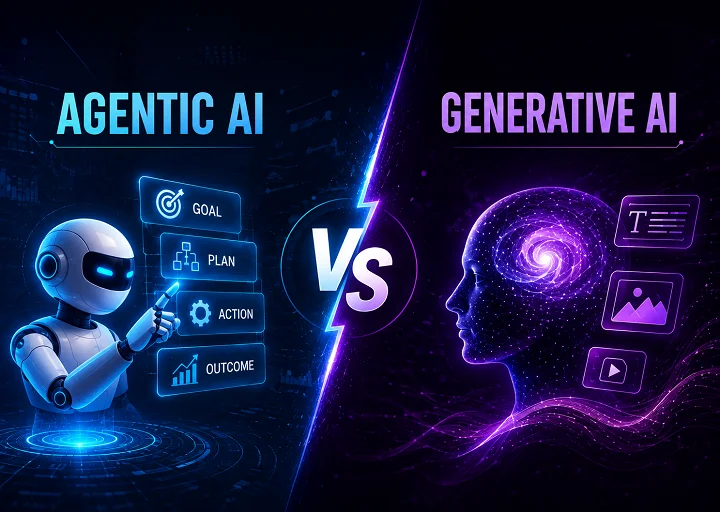
Definitions: Agentic AI, AI Agents, and Generative Models within Artificial Intelligence
Generative AI refers to systems that produce new content by recognizing and applying patterns learned from large datasets. Depending on the model, the generated output may include text, software code, images, audio, video, summaries, reports, or synthetic data.
These systems generally respond to prompts. A user provides an instruction, the model processes the available context, and the system returns an output.
Agentic AI is designed around goals rather than individual prompts. It can evaluate its environment, break a larger objective into smaller tasks, decide what to do next, interact with external systems, and modify its approach when circumstances change.
AI agents are the operational components within an agentic system. An agent may maintain context, interpret information, select tools, perform an action, review the outcome, and continue until it reaches a stopping condition.
The distinction can be understood through two questions:
Generative AI asks: “What content should be produced?”
Agentic AI asks: “What actions must be completed to achieve the goal?”
Traditional machine learning systems often perform a narrowly defined task, such as classifying an image, estimating demand, detecting fraud, or predicting customer churn. Generative systems create outputs, while agentic systems coordinate decisions and actions across a broader process.
How Agentic AI Works: AI Agents That Act Independently
Agentic AI commonly follows a continuous cycle of understanding, planning, acting, and evaluating.
First, the system collects relevant context. This information may come from user instructions, databases, applications, sensors, documents, APIs, previous interactions, or stored memory.
Next, the system converts the main objective into manageable subtasks. It may identify dependencies, determine the correct order of operations, and select the resources needed to complete each stage.
The agent then performs actions. Depending on its permissions, it might search a database, update a record, send a message, run code, generate a document, create a support ticket, or call another specialized agent.
After each action, the system evaluates the result. When an action fails or produces an unexpected outcome, the agent may retry, choose another tool, request approval, or revise its plan.
This ability to operate between user interactions is one of the defining characteristics of agentic AI. A generative AI tool usually waits for the next prompt. An agentic system can continue working through multiple steps without requiring a person to initiate every action.
More advanced architectures may include a supervisor agent that delegates work to specialized agents. One agent may retrieve information, another may analyze it, and another may perform an approved business action. The supervisor coordinates the process and determines when the objective has been completed.
Automated Workflow Management with Agentic AI
Workflow automation is one of the strongest applications of agentic AI.
Consider a customer inquiry submitted through a company website. An agentic system could retrieve the customer’s details from a CRM, evaluate the inquiry, categorize the opportunity, research the account, prepare a personalized response, assign the lead to an appropriate sales representative, schedule a follow-up, and record every action.
A generative AI model may draft the message, but the agentic framework manages the complete process.
Several capabilities make this possible:
Persistent memory: The system retains relevant information across different stages of the workflow.
Tool integration: Agents connect with business applications, databases, communication tools, analytics systems, and other services through APIs.
Conditional logic: The system selects actions based on data, policies, permissions, and previous outcomes.
Progress monitoring: The agent tracks completed steps and determines what remains unfinished.
Error handling: When a process fails, the system may retry the operation, use an alternative method, or escalate the issue to a human.
This approach can reduce the manual effort required for repetitive and rules-based processes. Employees can spend more time on strategic decisions, relationship management, creative problem-solving, and situations that require human judgment.
However, greater autonomy also creates greater operational responsibility. Organizations must carefully define what an agent is allowed to do, which actions require approval, and when the system must stop or escalate.
How Generative AI Works: LLM Foundations for Content Creation
Many generative AI applications are powered by large language models, or LLMs. These models are trained on extensive collections of text and learn statistical relationships between words, concepts, instructions, and patterns.
When a user submits a prompt, the model predicts and generates an appropriate response based on the prompt, available context, and its training.
Generative AI is particularly effective for tasks such as:
- Preparing content drafts
- Summarizing documents
- Generating or reviewing code
- Creating product descriptions
- Producing personalized messages
- Extracting information from text
- Generating synthetic datasets
- Answering questions in natural language
The typical interaction is reactive. The system receives a request and produces an output. Unless it is connected to an orchestration framework, it does not independently decide which applications to access or what actions to perform next.
Generative AI works especially well when a task has a clear scope and can be completed through a limited number of model interactions.
Retrieval-augmented generation, commonly known as RAG, can improve these systems by connecting them to external knowledge. Instead of relying only on information learned during training, the model can retrieve relevant material from company documents, databases, knowledge bases, or approved online sources before preparing its response.
RAG can improve relevance and factual grounding, but it does not automatically make an application agentic. A RAG-powered assistant may still respond only when prompted and leave subsequent actions to the user.
Agentic AI and Generative AI Working Together
Agentic AI and generative AI are not competing technologies. In many enterprise applications, they perform complementary roles.
Generative AI provides language understanding, reasoning support, summarization, drafting, and content creation. Agentic AI manages planning, sequencing, memory, application access, and execution.
For example, imagine an organization wants a weekly competitive intelligence report.
An agentic system could:
- Identify the relevant competitors.
- Retrieve recent information from approved data sources.
- Organize the findings by category.
- Ask a generative model to summarize important developments.
- Compare the results with previous reporting periods.
- Prepare a formatted report.
- Send the report to authorized stakeholders.
- Record the workflow for auditing.
The generative model creates and analyzes content during individual steps. The agentic system determines how those steps fit together and ensures that the complete process is executed.
This combination is becoming increasingly important in compound AI systems. Instead of relying on one model to handle every requirement, organizations can use specialized models, retrieval services, business rules, APIs, databases, and agents as coordinated components.
Agentic AI Vs Generative AI: Direct Comparison and Practical Criteria
The most important differences between agentic AI and generative AI relate to autonomy, workflow complexity, interaction style, infrastructure, and risk.
| Dimension | Agentic AI | Generative AI |
| Primary purpose | Completes goals through coordinated actions | Produces content in response to prompts |
| Interaction model | Proactive and goal-oriented | Primarily reactive |
| Workflow | Handles multi-step processes | Commonly handles individual or bounded tasks |
| Decision-making | Selects actions dynamically | Generates an output from the supplied context |
| Tool usage | Connects with APIs, databases, and applications | Usually provides content for a user or system to use |
| Memory | May maintain state across tasks and sessions | Often limited to the current interaction unless extended |
| Human involvement | Can operate with configurable levels of oversight | Users normally review or act on generated output |
| Infrastructure | Requires orchestration, monitoring, memory, and repeated model calls | Can operate through a simpler request-and-response architecture |
| Main risk | Unintended actions affecting operational systems | Incorrect, misleading, biased, or unsuitable content |
| Best suited for | Complex processes involving several decisions and systems | Content creation, summarization, analysis, and assistance |
The correct choice depends on the task.
When the desired result is a draft, summary, recommendation, image, code snippet, or analysis, generative AI may be sufficient.
When the desired result requires several connected steps, changing conditions, application access, and real-world actions, an agentic architecture may be more appropriate.
Use Cases: When to Choose Agentic AI and When to Use Generative AI
Agentic AI is suitable when a process requires the system to coordinate information and actions across multiple stages.
Potential applications include:
- Handling IT incidents from detection through resolution
- Coordinating employee or customer onboarding
- Monitoring supply chain conditions and adjusting workflows
- Managing document approval processes
- Processing insurance or financial service requests
- Performing multi-stage research and reporting
- Coordinating customer support across different systems
- Monitoring equipment and initiating maintenance processes
Generative AI is better suited to focused content and knowledge tasks, including:
- Drafting marketing materials
- Summarizing meetings or reports
- Generating software code
- Producing product descriptions
- Preparing email responses
- Creating synthetic test data
- Translating or adapting content
- Helping users search enterprise knowledge
Many business scenarios benefit from a hybrid model.
A software development workflow could use generative AI to suggest code, explain errors, and draft documentation. An agentic system could assign reviews, run approved tests, check deployment conditions, track unresolved issues, and notify stakeholders.
Similarly, a marketing operation could use generative AI to develop campaign content while an agentic system coordinates approvals, audience segmentation, scheduling, distribution, and performance reporting.
Industry Examples Emphasizing Automated Workflow Management
Cybersecurity: Threat Detection and Response
Cybersecurity teams must process large volumes of alerts while responding quickly to genuine threats.
An agentic security system can monitor logs, correlate suspicious events, retrieve threat intelligence, evaluate risk, and recommend or initiate a response. Based on organizational policies, it could isolate an endpoint, disable compromised credentials, block a suspicious network address, or create an investigation case.
Generative AI can assist by summarizing incidents, explaining attack patterns, preparing investigation notes, and translating technical findings into executive reports.
Because security actions can affect critical systems, organizations need strict permissions, approval thresholds, detailed logs, and clearly defined escalation procedures.
Healthcare: Continuous Patient Monitoring
Agentic AI can support continuous monitoring by evaluating patient information over time rather than waiting for a clinician to submit a query.
A system might review vital signs, medication adherence, symptoms, device readings, and historical information. When predefined risk conditions are detected, it can alert an authorized care team or initiate an approved workflow.
Generative AI can convert complex medical information into summaries, draft patient communication, or help clinicians navigate approved knowledge resources.
Healthcare implementations require strong privacy protections, clinical validation, regulatory compliance, and human oversight. AI should support qualified professionals rather than independently replacing clinical judgment.
Finance: Real-Time Risk and Market Analysis
Financial institutions process rapidly changing information related to markets, credit, fraud, compliance, and customer activity.
An agentic system can continuously collect relevant data, compare it with institutional policies, identify unusual conditions, and initiate approved risk-management processes.
For example, it might flag a transaction, request additional verification, adjust an internal risk score, or escalate an account for human review.
Generative AI can support analysts by summarizing market developments, preparing reports, explaining risk indicators, and extracting information from financial documents.
Since financial actions can create significant consequences, organizations must maintain approval controls, model validation, auditability, and limits on autonomous decision-making.
Marketing: Gen AI for Content Creation at Scale
Marketing is one of the most widely adopted areas for generative AI.
Teams can use generative models to create first drafts, develop campaign variations, personalize messages, generate social media content, summarize customer feedback, and prepare creative concepts.
Human teams remain responsible for brand consistency, legal review, factual accuracy, campaign strategy, and final approval.
Agentic AI can extend these capabilities by managing the surrounding workflow. It can collect campaign requirements, assign tasks, coordinate approval stages, schedule approved materials, update campaign systems, and compile performance reports.
The result is a coordinated process in which generative AI supports content production while agentic AI supports execution.
Deployment, Infrastructure, and Inference Considerations for AI Technology
Agentic systems generally require more complex infrastructure than standalone generative AI applications.
A conventional generative AI request may involve a single model call: the system receives a prompt and returns an answer.
An agentic workflow may require many model calls. The agent might analyze a goal, retrieve data, choose a tool, interpret the result, make another decision, validate the outcome, and repeat the cycle.
As the number of steps increases, organizations must account for:
- Model inference costs
- Processing latency
- API reliability
- State and memory management
- Authentication and authorization
- Tool availability
- Error recovery
- Observability and monitoring
- Data security
- Workflow interruption and resumption
Tasks that demand immediate decisions may require low-latency infrastructure and scalable model serving. Less urgent operations may use scheduled or asynchronous processing to control costs.
Edge environments, connected devices, and industrial applications may require smaller models that can operate with limited computing resources and unreliable connectivity.
Infrastructure planning should begin with the nature of the workload. Organizations need to determine whether the application requires a single generated response or a sustained sequence of decisions and actions.
Governance, Safety, and Trust for Agentic AI and Generative AI
Generative and agentic systems create different categories of risk.
Generative AI primarily introduces informational risks. A model may produce inaccurate statements, unsupported conclusions, inappropriate content, biased outputs, insecure code, or material that does not follow company policies.
Agentic AI also introduces operational risks because it can act within real applications. An incorrect generated answer may misinform a user, while an incorrect agentic action may update a database, send a message, approve a request, modify a system, or initiate a financial process.
Agentic governance should include several safeguards.
Human approval thresholds: High-impact actions should require authorization before execution.
Least-privilege access: Each agent should receive only the permissions necessary for its specific function.
Complete audit trails: Organizations should record model interactions, retrieved data, decisions, tool calls, approvals, and outcomes.
Action limits: Policies should restrict transaction amounts, modification rights, communication channels, and accessible systems.
Testing and evaluation: Agents should be assessed for accuracy, reliability, safety, policy compliance, and their ability to handle unexpected conditions.
Emergency controls: Administrators should be able to pause workflows, revoke access, or disable agents immediately.
Data governance: Systems should respect privacy obligations, residency requirements, retention policies, and user consent.
Governance should be incorporated during architecture and design. Adding controls after an agent has already been connected to production systems can create unnecessary risk.
Trends and Future Direction: Agentic AI vs Generative Convergence
The separation between generative and agentic AI is becoming less distinct.
Generative models are increasingly used as reasoning and language components within agentic systems. At the same time, generative AI products are gaining memory, tool access, planning capabilities, and workflow integrations.
Future enterprise systems are likely to rely on coordinated collections of models and agents rather than one general-purpose model.
A specialized model may analyze an image, another may extract information from documents, and another may generate a customer-facing explanation. An agentic layer can determine which component to use, transfer information between them, and manage the broader objective.
Interoperability will also become increasingly important. Organizations need reliable methods for connecting agents with applications, data platforms, models, identity systems, and other agents.
As standards mature, businesses may be able to assemble AI capabilities more easily and select the most appropriate model or tool dynamically for each stage of a process.
Despite these advances, human accountability will remain essential. Organizations must continue to define objectives, boundaries, quality standards, permissions, and acceptable levels of autonomy.
Conclusion: Choosing Between Agentic AI and Generative AI
The decision between generative AI and agentic AI should begin with the structure of the business problem.
Generative AI is usually the appropriate choice when the goal is to create, summarize, transform, explain, or analyze information within a clearly bounded interaction.
Agentic AI is more suitable when the system must pursue an objective across multiple steps, make decisions based on changing information, interact with external applications, and complete actions with limited human prompting.
For many organizations, the strongest solution will combine both approaches. Generative models can provide language, reasoning, and content-generation capabilities, while agentic systems manage workflows, memory, decisions, and execution.
Before starting a project, organizations should:
- Define whether the task is single-step or multi-step.
- Determine the required level of autonomy.
- Identify the applications and data sources involved.
- Estimate the infrastructure needed for repeated model interactions.
- Define which actions require human approval.
- Establish access controls and audit requirements.
- Test the system under normal, unexpected, and adversarial conditions.
- Begin with a controlled pilot before expanding into critical operations.
The objective is not to choose the most advanced form of AI. It is to select the architecture that solves the problem effectively while maintaining reliability, transparency, security, and human accountability.

Comments are closed.
2 Comments-
Pingback: Types of AI for Small Businesses: Examples, Benefits & Use Cases
-
Pingback: Agentic Commerce: The Future of AI-Powered Retail