Innovate
  Accelerate
  Engineers & Experience
  Quality Assurance
  Salesforce
  Application Development and Maintenance
  Full Cycle Development
  Consulting Services
  Staff Augmentation
  eCommerce
  Education
  Fintech
  Health & Wellness
  Healthcare
  Logistics
  Media & Entertainment
  Real Estate
  Travel
  Sports




There is an extraordinary amount of information on the internet, listing products, research findings, news, and reviews of customers, among others. Extracting that information effectively can unlock effective insights for a business, researchers, as well as developers. Web scraping is where that is involved.
Web scraping is a computerized methodology that is deployed in order to gather abundant data from websites. Most web data is written in HTML format, the browsers’ formats, and not the analysis. This data is scraped and transformed into the more structured formats of CSV files, spreadsheets, or databases, which might be easier to analyze or make use of.
The information may be collected using APIs, online scraping systems, or ad hoc written scripts. Although the large sites, like Google, Twitter, and Facebook, have APIs that could allow access to their data in a structured manner, smaller sites do not have them or have limited access. Web scraping would be an effective solution in those cases.
At its core, web scraping typically involves two main components:
- Crawler: A program or algorithm that navigates websites by following links and discovering pages containing relevant data.
- Scraper: A tool that extracts specific information from web pages. Its structure and complexity depend on the requirements of the project.
Together, these components automate the process of browsing, identifying, and collecting web-based information.
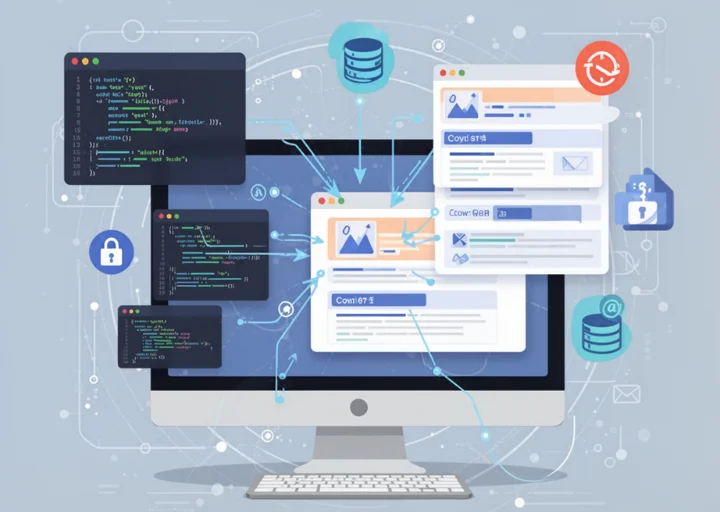
How Web Scrapers Work?
Web scrapers have the ability to retrieve all the information on a webpage or to retrieve particular information. In a majority of applications, only the information that you need can be improved by concentrating on that information.
Indicatively, when examining an Amazon page of the product availability, you might only require the names of products and their prices, but not reviews, pictures, or ratings made by customers. The predefinition of these parameters will allow the scraper to operate more quickly and prevent the situation with the absence of data processing.
Web Scraping End-to-End Flow
A normal web scraping process follows the following steps:
- Input: You enter the URLs and you indicate the exact data that you would wish to extract (such as product name and price).
- Requirement: The scraper uses the HTTP request type of the GET method to the individual URLs, just the way a web page is loaded in the web browser.
- Load: HTML content is downloaded. In dynamic websites, some JavaScript can be required which will inherently render the page.
- Parse: The HTML is transformed to structured form sometimes referred to as a parse tree that enables the scraper to navigate the page elements.
- Extract: With the help of such selectors as CSS selectors or XPath, the scraper recognizes the desired data segments and pulls them.
- Clean: Raw data is optimized- unnecessary spaces are deleted, format is standardized and values are arranged into rows and columns.
- Paginate: When it has more than one page, uses Next links to go through the pages and repeat the scraper, until all pages with the relevant information are scraped.
- Save: The cleansed data is saved in such formats as CSV, Excel, JSON, or even a database.
Such systematic data collection guarantees that data are collected in a systematic way, consistently and in a scalable manner.
Types of Web Scrapers
Web scrapers can be categorized based on development type, platform, and execution environment. Understanding these categories helps determine the right tool for your project.
Based on Development Type
Self-built Web Scrapers
These scrapers are created from scratch using programming languages such as Python or JavaScript. They:
- Require strong coding skills
- Offer complete customization
- Allow advanced logic and automation
- Provide flexibility for complex projects
Self-built scrapers are ideal for developers who need tailored solutions or large-scale automation.
Pre-built Web Scrapers
These are ready-made tools that users can download or access online. They:
- Feature user-friendly interfaces
- Require little to no coding knowledge
- Provide configurable settings
- Are suitable for beginners and non-technical users
Pre-built scrapers are a practical choice for quick projects or teams without dedicated developers.
Based on Platform
Browser Extension Web Scrapers
These tools operate as extensions within browsers like Chrome or Firefox. They:
- Are easy to install and use
- Work well for small-scale tasks
- Require minimal setup
However, they are limited by browser capabilities and may struggle with complex or high-volume scraping.
Software Web Scrapers
Installed as standalone applications, these scrapers:
- Offer more advanced functionality
- Handle larger datasets
- Are not restricted by browser limitations
They require installation and system resources but provide greater flexibility and power.
Based on Execution Environment
Cloud Web Scrapers
Cloud-based scrapers run on remote servers managed by service providers. They:
- Do not consume your local CPU or RAM
- Allow continuous scraping without affecting your device
- Support large-scale and automated operations
This option is ideal for businesses handling significant data volumes.
Local Web Scrapers
Local scrapers run directly on your computer. They:
- Use your system’s CPU and memory
- Offer full control over operations
- May slow your system during intensive tasks
They are suitable for smaller projects or environments with strong hardware capabilities.
Why is Python a Popular Programming Language for Web Scraping?
Python has become an ideal choice in web scraping because of its simplicity, flexibility, and large library base. Its density and easy syntax make it usable to a new user, and its robust structures can be used to perform any complicated task of data extraction.
There are two popular Python web scraping tools:
- Scrapy: This is an open-source web crawling framework that is used to do large-scale scraping and API data scraping. It has built-in support of request handling, data pipelines, and structured exports.
- Beautiful Soup: A library that reads and parses HTML and XML documents to create a tree structure that can be navigated. It makes it simpler to search the web pages and edit and extract data.
Python is also compatible with data analysis packages like Pandas, and it is easy to transition between extraction and analysis. This is an end-to-end feature, which explains why Python remains the most popular web scraping project.
What is Web Scraping Used For?
Web scraping is useful in a vast field of industries such as e-commerce, finance, media and marketing. Some of the most frequent applications of it are shown below.
1. Price Monitoring
Web scraping is common with businesses to monitor competitor prices. Gathering information about the products on other websites, the company is able to predict the trends in pricing and modify their strategies to meet the demands of the market. This helps them to be competitive and maximize revenue.
As an illustration, the retailers are in a position to detect the changes in prices in various marketplaces automatically and react swiftly to developments.
2. Market Research
Big data collection offers useful information on how consumers behave, the new trends and demands. Scraped data can be used by companies to:
- Identify product gaps
- Competitor analysis.
- Forecast demand shifts
- Lead product development decision-making.
The quality of structured data is high and enables more accurate and data-driven strategies.
3. News Monitoring
Companies usually depend on the news that happens in real time and influences their performance or image. Companies can scrap news websites to:
- Citations of their brand.
- Keep track of what is happening in the industry.
- Identify potential risks
Information on a timely basis can be very important in the fast-paced industries.
4. Sentiment Analysis
Brand development requires knowledge of the opinion of the people. Web scraping enables the companies to accumulate information on social media sites, forums, and review sites to determine customer mood.
Businesses can assess comments, feedback, and discussions by analyzing them and thus:
- Determine customer satisfaction.
- Identify recurrent complaints.
- Enhance products and services.
- Enhance customer relations.
Sentiment analysis assists organizations to keep in line with the expectations of consumers.
5. Email Marketing
Web scraping is also utilized by some businesses to gather publicly available email addresses to be used in outreach and promotion. This is possible to support the lead generation efforts as long as they are done in a responsible manner and within legal provisions.