Innovate
  Accelerate
  Engineers & Experience
  Quality Assurance
  Salesforce
  Application Development and Maintenance
  Full Cycle Development
  Consulting Services
  Staff Augmentation
  eCommerce
  Education
  Fintech
  Health & Wellness
  Healthcare
  Logistics
  Media & Entertainment
  Real Estate
  Travel
  Sports




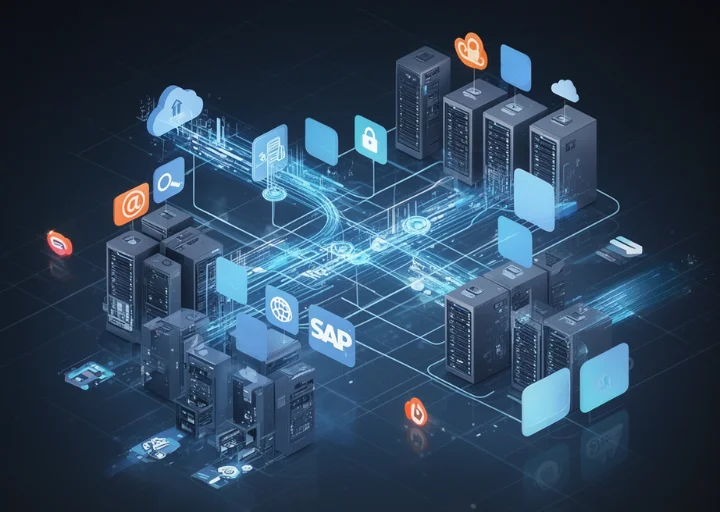
SAP is one of the world’s most prominent developers of software designed to manage and integrate business operations. Its solutions allow organizations to coordinate everything from finance and supply chain to human resources and customer relationships in a unified system. Instead of managing separate tools for each department, SAP provides a centralized platform that connects processes and data across the entire organization.
Overview
SAP SE was established in 1972 as a small project of five innovators who had a common vision of making a change in the business using technology. The company is now a global technology leader based in Walldorf, Germany, with more than 105,000 employees holding various job opportunities in many countries.
SAP started off on the right foot with its SAP R/2 and SAP R/3 systems, establishing new standards in enterprise resource planning (ERP). The platforms allowed firms to automate and organize business in unimaginable ways. SAP did not stop developing its solutions over time until it was able to respond to the needs of more digital and data-driven organizations.
The SAP S/4HANA ERP platform is nowadays the flagship product of SAP, and it is one of the significant steps forward that enterprise technology has made. It relies on in-memory computing, which has enabled organizations to interpret large volumes of information within seconds. The capability also helps in emerging technologies like artificial intelligence and machine learning so that businesses can automate work, forecast, and react very fast to changing conditions.
Currently, the ecosystem that SAP participates in has more than 230 million cloud users and over 100 specialized applications developed to support virtually all business activities. These processes can be linked together in one intelligent platform and have been integrated in SAP software through finance and procurement to the sales and workforce management. This gets rid of weary and worn legacy systems and introduces updated and linked surroundings.
Another key aspect in the further success of SAP is leadership. Christian Klein is the current CEO and holds the Executive Board position of the company. He is among the youngest chairs of a big corporation in the list of the DAX index in Germany
What does SAP stand for?
The name of the acronym SAP derives from the original name of the company in Germany, System analyse Programmentwicklung, which means System Analysis Program Development. The name is a representation of the initial mission of the company, which is to develop software to analyse and optimize business processes.
The company has its current corporate name of SAP SE. SE is the short name of Societal European, the type of legal person that is a recognized public company under the corporate law in the European Union. This label enables SAP to work effectively in the space of the European markets and retain its global presence.
What does SAP do?
Essentially, SAP builds software to assist organizations to run more effectively, be flexible, and experience growth in the long run. SAP solutions are implemented in companies of all industries-manufacturing, healthcare, retailing, banking, and technology-to run their operations and enhance performance.
Through SAP, businesses are able to integrate various departments and functions in one system. The integration enables companies to get the right real-time information, which assists leaders in making decisions that are better and responding more quickly to either opportunities or challenges.
What is SAP software used for?
The old business systems tend to store information differently in various departments. Indicatively, different databases could be used by finance, sales, and inventory teams. This division introduces inefficiencies, reduces visibility, and increases the chances of errors and duplication of information.
The solution to this issue is through SAP, which consolidates data into a single system. Employees in various departments can access the same up-to-date information, which is accurate and not disconnected like what is the case with the disconnected tools. Such a common data space enhances the efficiency of cooperation, minimizes mistakes, and provides uniformity.
Organizations are able to do so with SAP software:
- Automation of routine business processes.
- Watch real-time operations.
- Enhance productivity and efficiency.
- Improve customer satisfaction and service.
- Reduce operational costs
- Make decisions more quickly and based on data.
Finally, SAP allows businesses to run more readily and manageably so that they can stay afloat in the ever-evolving market.
What is ERP software?
ERP is an acronym used to mean Enterprise Resource Planning. The ERP software incorporates key functions of the business into a single system. These functions normally incorporate:
- Finance and accounting
- Procurement and purchasing
- Inventory and supply chain management.
- Customer and sales management.
- Marketing operations
- Workforce management and human resources.
- Production and manufacturing.
SAP is acclaimed as a leader in the ERP technology. Its solutions have assisted in developing the manner in which the current business world functions by substituting manual procedures and fragmented systems with smart and automated processes.
ERP software such as SAP is efficient in addition to offering insights. With real-time information, business leaders are able to analyze performance and identify trends in order to make strategic decisions.
SAP Solutions
Cloud ERP: Cloud ERP is an approach where businesses run the fundamentals of business, including financial, procurement, and sales, along with inventory, using cloud systems, and providing flexibility, scalability, and accessibility without having to use on-premise infrastructure.
Business Technology Platform: A business technology platform enables the organization to combine applications, manage data, and create its own solution, which will facilitate the linking of systems and enhance the consistency of information in business processes.
Artificial Intelligence: Artificial intelligence can help to automate and analyze a great deal of data and make predictions, which enables businesses to improve their efficiency, reduce human labour, and help make smarter decisions.
Supply Chain Management: The solutions of supply chain management help the companies to track inventory and logistics, harmonize the suppliers, and improve the visibility across the whole supply chain to reduce delays and streamline the operations.
Financial Management: Financial management systems make accounting, budgeting, reporting, and compliance simpler and help organizations in monitoring financial performance and also in maintaining good financial records.
CRM and customer experience: CRM and customer experience solutions help companies to manage the information about the customers and track their interactions, sell, market, and deliver services in order to make them more satisfied and interact more.
Spend Management: Spend management software can also help companies to control their purchasing, manage their suppliers, monitor their costs, increase financial transparency, and reduce avoidable costs.
Human Capital Management: Human capital management systems are employed to equalize employee data, recruitment, payroll, performance, and workforce planning to improve HR productivity and employee lifecycle management.
Small and Midsize Enterprise Solutions: Small and midsize enterprise solutions provide scalable solutions to small and midsize businesses to manage their business processes in an efficient manner that allows small organizations to simplify business operations and support their growth.
Industry Solutions: Industry solutions are developed in response to the operational and regulatory needs of different industries, such as the manufacturing, healthcare, retail, and finance industries.
Business Network: Business networks enable organizations to be online in contact with the suppliers, partners, and customers, which improves collaborations, communication, and management of transactions.
Additional Resources
Documentation: Documentation includes extensive technical and functional information that assists users to learn how the system works, how it can be configured, and business processes.
Online courses: The online courses provide systematic learning to enlighten the learners about enterprise software and other concepts using videos, exercises, and practical examples.
Books and guides: Books and guides describe enterprise systems, digital transformation, and business process management in an elaborate and well-organized manner.
Professional communities: Professional communities and forums enable users to communicate with others, ask questions, and learn from real-life experiences.
Training workshops and training: training programs offer practical knowledge and first-hand experience in working with enterprise systems.
Practice environments: Practice environments enable learners to experiment with software in a safe environment and also provide them with real-world experience without impacting live business operations.
Industry blogs and publications offer information on fashions, developments, and best practices in enterprise software and business technology.
FAQs
Was SAP a startup?
Yes, SAP was at first a startup that was started by five former IBM employees: Dietmar Hopp, Klaus Tschira, Hans-Werner Hector, Hasso Plattner, and Claus Wellenreuther. They had a daring dream to come up with software that could unify business operations and give real-time information.
The founders have been closely in contact with the customers during its early days, and at times they shared their offices. This practical learning enabled them to learn real-life business problems and come up with effective solutions to the problems.
In the long run, SAP has grown in terms of innovation, partnerships, and strategic acquisitions. What began as a small firm later grew to be one of the biggest and most powerful technology firms in the world. SAP has been able to preserve its initial emphasis on being innovative and providing real-world business solutions despite its growth.
What is SAP Ariba?
SAP Ariba is one of the featured procurement and spend management solutions bought by SAP in 2012. It assists the business in better controlling purchasing and supplier relations as well as controlling spending.
SAP Ariba enables businesses to access suppliers, get contracts, follow purchases, and obtain insight into spending patterns. Better procurement processes can help organizations cut down costs, enhance efficiency, and develop better relations with suppliers.
What is SAP S/4HANA?
SAP S/4HANA is the new-generation ERP system of SAP, which is meant to serve the new digital business. It embraces smart technologies, including artificial intelligence, machine learning, and superior analytics.
The system is powered by SAP HANA, which is an in-memory database that processes information in real time. This enables businesses to process large volumes of data in real time, which can be used to make decisions faster and have greater efficiency in their operation.
The SAP S/4HANA makes data structures easier to manage and simplifies their complexity, increasing the ease with which an organization can manage its operations as they prepare to grow in the future.
What is SAP Business AI?
SAP Business AI puts AI directly into the business processes. It is not used as a separate tool but as an element of daily operations.
The technology has the benefit of automating repetitive duties, enhancing the accuracy of forecasts, and making intelligent suggestions. It links the important business functions, including finance, supply chain, human resources, sales, and customer service.
Embarking on AI in business processes, SAP assists organizations in running smarter and more efficiently.
What is innovation at SAP?
SAP has the mission of innovation. The firm creates new technologies that assist the business in achieving performance as well as adapting to the times.
SAP exploits sophisticated technologies such as artificial intelligence, machine learning, and data analytics to convert raw data into reasonable insights. These are insights used to help companies know their present performance and strategize for the future.
Besides enhanced efficiency, SAP also aims at sustainability and responsible business practice. Its solutions assist organizations in cutting waste, optimizing resources, and conducting operations in a responsible manner for the environment.
SAP has been able to make its mark in shaping the future of enterprise technology by innovating and applying it in practical business processes.